
As the design industry continues to address its environmental impact, material innovation has become a critical area of focus. With nearly 40% of global carbon emissions linked to the construction sector, the need for low-carbon alternatives is no longer optional, it’s essential.
In this context, Low Carbon Industrial (LCI) has introduced a new approach to material development, one that moves beyond adapting existing systems and instead builds sustainability into the foundation.
Founded by the team behind Foresso, LCI marks a natural progression in thinking. Where earlier work demonstrated the importance of combining strong design narratives with responsible sourcing, LCI has taken that further, developing materials that are conceived with circularity and carbon reduction from the outset.
As co-founder Conor Taylor has noted, the aim has been to create materials that reflect what the design community is increasingly asking for: solutions where sustainability is not an add-on, but an inherent quality. This shift has been driven not just by manufacturers, but by clients and specifiers who are actively shaping demand for lower-carbon outcomes.
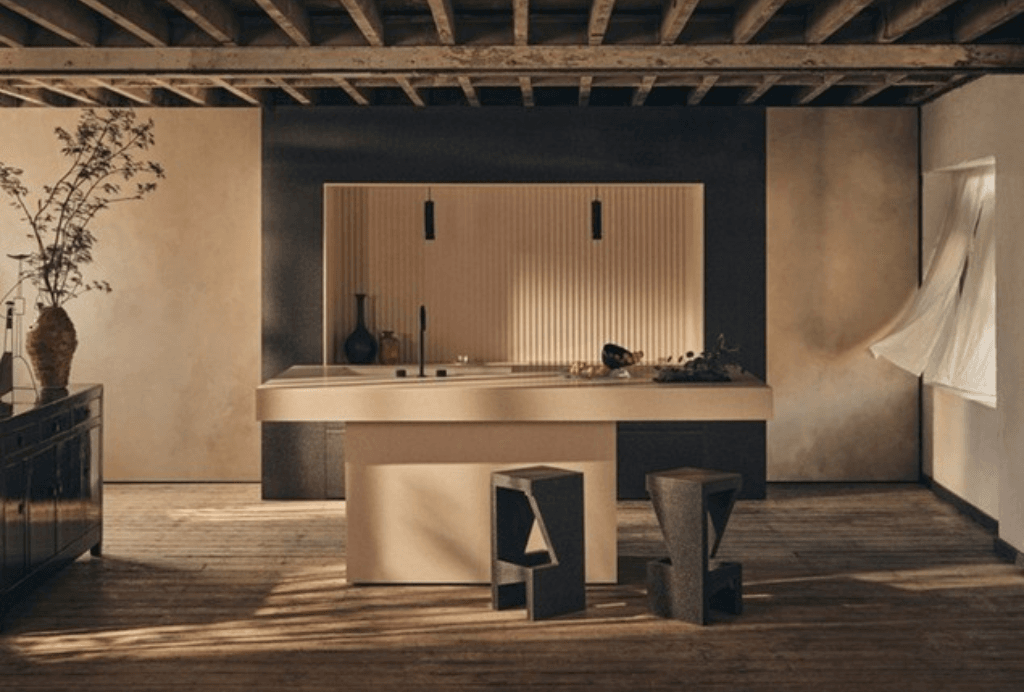
At the centre of this approach is Elenite, LCI’s first material. Developed to demonstrate that lower-carbon products can meet the same performance and aesthetic expectations as traditional options, it represents a move towards making sustainable choices the default rather than the exception.
Co-founder Jake Solomon has emphasised that Elenite was designed to avoid compromise. It has been developed to be durable, fabricator-friendly and visually expressive, ensuring it works within the realities of design and construction projects while delivering a reduced carbon footprint.
This balance is key. Sustainable materials have often been positioned as niche alternatives, requiring trade-offs in usability or design flexibility. LCI’s approach challenges this by showing that environmental intelligence can be integrated into materials from the beginning, supporting both creative and practical requirements.
The introduction of Elenite has also signalled a broader ambition. With additional materials already in development, LCI is working towards a portfolio that supports a more circular and responsible approach to interiors.
More widely, this reflects a shift across the industry. Designers, manufacturers and clients are increasingly aligned in their expectations, moving towards solutions that prioritise transparency, performance and lower environmental impact.
LCI’s direction suggests that the future of materials will not be defined by compromise, but by integration, where sustainability, design and performance are considered together from the very start.