

November Webinars from Global Offshore Wind
Tuesday 3rd November, 1500CET
Significant Wave Height: How Real-Time, Localised Data Enhances Operational Safety, Efficiency & Performance
Guests from Bibby Marine Services and Red Ensign Solutions discuss the benefit of real-time wave data for various stakeholders in offshore wind.
Register here: https://info.miros-group.com/how-real-time-localised-data-enhances-operations

Wednesday 4th November, 1500CET
Miros Cloud: Easy, Secure Access to Sea State Data
Miros provides easy and secure access to real-time, local sea state data through Miros Cloud. We'll explore the technology, security and functionality of this platform.
Register here: https://info.miros-group.com/easy-secure-access-to-sea-state-data

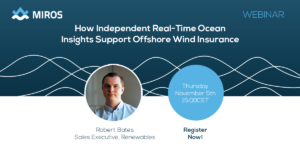
Thursday 5th November, 1500CET
How Independent Real-Time Ocean Insights Support Offshore Wind Insurance
We'll be unpacking the benefits of real-time ocean insights for a range of use cases, including weather risk insurance, asset integrity and O&M.
Register here: https://info.miros-group.com/independent-ocean-insights-offshore-wind-insurance

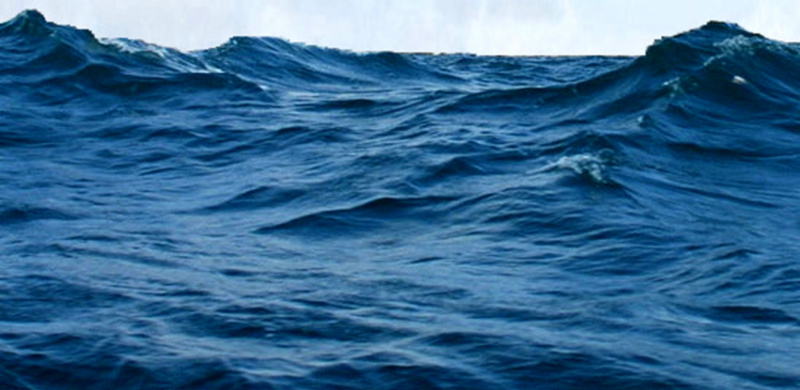
Oceanology International 2020 goes virtual; Oceanology International Americas postponed
Oceanology International 2020 goes virtual; Oceanology International Americas postponed
Oceanology International 2020 is to be held virtually, bypassing the current doubts over worldwide travel and quarantine restrictions whilst bringing the Oceanology community together in a fresh, innovative way through the Oi Connect events and meetings platform. Moving to a virtual exhibition ensures that it will be open to everyone, sidestepping travel times and logistics and uniting the global ocean tech audience.
Event organisers Reed Exhibitions have also postponed Oi Americas – originally planned be held in San Diego in February 2021 – until 2023. Oi Connect 2020 will instead serve a worldwide audience in what promises to be the largest coming-together of the ocean technology sector since restrictions began, joining the best of both shows in a single, truly international event.
“The announcement by the UK Government that exhibitions will continue to be disallowed, combined with global uncertainty as the coronavirus pandemic continues, have confirmed our decision to move forward to 100% virtual with Oi Connect and to postpone Oi Americas,” said David Ince, Events Director, Reed Exhibitions. “While it is disappointing to temporarily relinquish the undisputed benefits of physical meetings, demonstrations and networking opportunities, we need to take collective responsibility for the safety of our exhibitors, visitors and staff.
“The team at Oi are well advanced in converting their two years of planning for the physical event into a unique and exciting opportunity to showcase the global marine science and oceanology community in a different, virtual way. We wholeheartedly look forward to blazing a new trail in virtual events with Oi Connect, aiding the industry in moving forward and demonstrating how resilient we can be.”
Oi Connect is an AI driven meetings and virtual event platform, going far beyond conventional videoconferencing facilities and building on the core values of physical Oceanology events to create a forum in which participants can discover innovation, learn about the latest developments in the maritime industry, attend presentations and hold face-to-face conversations. Once a registered attendee for the event has created their personal profile, this powerful tool will assist in finding valuable networking connections and generating high quality 1-2-1 meetings. They will be able to search visitors and exhibitors, identify key contacts based on their areas of interest and job types, build relationships and create business opportunities – resulting in a pre-planned roster of private virtual meetings throughout the event. A team of matchmaking professionals will support the service, assisting with arrangements, aiding with any technical questions and managing the online meetings lounge.
Oi Connect will also facilitate the Oceanology conferences, which provide technical and business insights and an opportunity to explore how connections can help underpin and grow the industry.
Oi Connect will be launching to Exhibitors and Visitors shortly and is open for anyone to attend virtually. The Oi team will be sharing full details with the community soon, and will be on hand to support visitors and exhibitors in their use of the platform and to help maximise their engagement with the global maritime audience. To find out more, and to explore opportunities still available for exhibiting with Oi Connect, visit oceanologyinternational.com.

Ultrabeam and USS team up to deliver Autonomous Pipeline Survey
Ultrabeam Hydrographic, a multi-award winning, dynamic and agile hydrographic survey company, recently teamed up with Unmanned Survey Solutions (USS) to conduct two subsea gas pipeline inspection surveys in Northern Ireland. Both companies are based in the UK and offer unmanned platforms as an alternative to traditional manned survey vessels.
The contract was awarded by Mutual Energy who were keen to gain experience on how unmanned autonomous platforms can increase the knowledge of their pipelines whist reducing risk and overall cost. Shane Rafferty, Group Engineer explained ‘Mutual Energy contracted with Ultrabeam Hydrographic in August 2020, following an open competitive tendering process, to perform inspection surveys of our Larne and Belfast lough crossing pipelines, key components of Northern Ireland’s natural gas transmission network. In a first for Mutual, an Unmanned Survey Vessel (USV), the “USS Accession”, provided by Ultrabeam’s project partners Unmanned Survey Solutions, was to be deployed. The project planning phase moved swiftly and seamlessly such that execution of the works commenced only a matter of a few weeks later, and was performed as programmed despite some inclement weather and sea states. We were pleased to see early data capture and quality provide assurance of equal standards to previous surveys, such that the assets could be returned a clean bill of health. Mutual Energy would like to thank the entire project team from Ultrabeam Hydrographic and Unmanned Survey Solutions for their diligence and expertise in successfully delivering the project, and can commend the benefits of the innovative technology for such nearshore surveys’
The challenges faced by these route surveys were solved by using an Accession Class USV built by USS. This 3.5m USV was fitted out with an R2SONIC 2024 high resolution multi-beam sonar, SBG Ekinox Navsight Inertial Navigation System and sound velocity sensors from Valeport. The data was acquired in QINSy which was also used as the autopilot for the autonomous line running. James Williams commented ‘the survey conditions were marginal with strong winds, tidal currents and waves however the vessel’s stabilisation fins ensured that the data was exceptionally clean. We were also able to get closer inshore than on any previous surveys using manned vessels. The vessel was really put through its paces on these deployments and I’m pleased to say that it performed beyond everyone’s expectations’.
Ultrabeam is backed by decades of experience in coastal hydrographic and geophysical survey. They also build their own unmanned platforms for detailed sonar and laser asset inspection. Project Manager Simon Baldwin commented; ‘’We are very happy to have provided Mutual Energy with a great dataset and deliverables as part of their 2020 subsea pipeline inspection campaign. The environmental conditions on site in Northern Ireland were far from benign and the USV and operational team worked faultlessly to provide great bathymetric data, safely and efficiently. This project was an ideal opportunity for us to continue to show what can be achieved autonomously, on schedule and to a high standard.’’
Two pipeline surveys were conducted along the Larne and Belfast Loughs using the Accession 350 USV. The weather was marginal, no incidents occurred and the project was completed on time and to budget. The joint venture between Ultrabeam and USS proved that autonomous surveys of inshore pipeline can be conducted safely and cost effectively compared to traditional manned solutions.
More info:
www.unmannedsurveysolutions.com
RS Aqua’s Underwater Acoustic Recorder deployed on the Mayflower Autonomous Ship
After its official launch in September, the Mayflower Autonomous Ship is now undertaking testing to prepare for its transatlantic voyage in Spring 2021.
An RS Aqua Porpoise passive acoustic recorder will be deployed on the ship, and will collect a broad spectrum of underwater noise data throughout the voyage. These data will be automatically processed and categorised by IBM systems on the Mayflower, ready for further analysis by University of Plymouth marine mammal experts. The Porpoise recorder is uniquely suited to the challenge as it can stream its data over Ethernet for real time processing, and has a broadband listening capability that can hear everything from low human made noise to the highest frequency ultrasonic cetacean vocalisations. These data will form the first ever autonomously recorded soundscape of the Atlantic Ocean and give a unique insight into the different marine mammal species encountered by the Mayflower.
Dr Ryan Mowat, Director at RS Aqua commented: “Specifying and providing the Mayflower with a customised version of one of our Passive Acoustic Monitoring recorders was a proud moment for RS Aqua. We’ve found that the streaming capability of our recorders is a necessity for autonomous platforms as it allows these vessels to interpret their environment acoustically in real time. Our recorders can provide an acoustic assessment of the surrounding marine environment as they move through it, and this is important for all sorts of applications, such as vessel navigation, asset tracking, marine mammal observation and defence. This is the fifth unique recorder integration we’ve done, and we’ll be working closely with the Mayflower team during the vessel trials to ensure it is optimised to gather new data on North Atlantic cetacean populations.”
For more information, visit https://www.mas400.com/technology and www.rsaqua.co.uk .
Fugro deploys latest RAMMS technology to map Lake Huron for Canadian Hydrographic Service
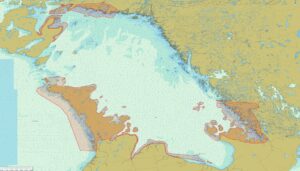
Fugro is mobilising its Rapid Airborne Multibeam Mapping System (RAMMS) to Ontario, Canada, to acquire 3147 km2 of high-resolution bathymetry data over Lake Huron for the Canadian Hydrographic Service (CHS). The survey is expected to last 6 months from data collection to data delivery and will support the agency’s ongoing nautical charting updates in the country’s Great Lakes region.
Fugro has used RAMMS throughout North America, the Caribbean and Europe since launching the next-generation airborne lidar system in 2018. In addition to nautical charting, RAMMS has supported offshore wind, coastal management and sea-level rise projects, in line with Fugro’s strategy of expanding into new growth markets related to energy transition and climate impact mitigation. For Lake Huron, the innovative technology will enable efficient and accurate data acquisition, despite multiple site-related challenges, including extensive areas of shallow water, complex coastlines, and relatively sparse coastal infrastructure.
“We are delighted to use our RAMMS technology on this survey for the CHS,” said Mark MacDonald, Hydrography Director for Fugro in the Americas. “The system’s unique design delivers high resolution data and penetrates to water depths that meet both the demands of this survey and the specifications required for nautical charting products.”
MacArtney Completes LARS Delivery for Fifth Ocean Research Vessel to Asia Pacific Operations
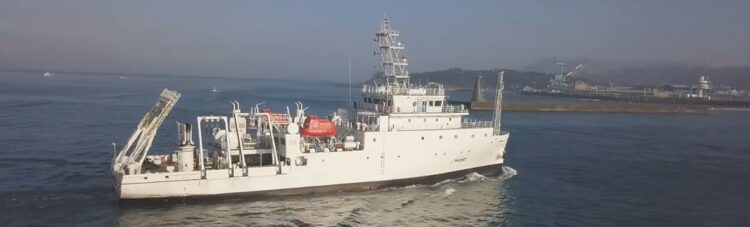
MacArtney has successfully completed its order of a launch and recovery (LARS) system for end-user Taiwan National University, marking the fifth Ocean Research Vessel (ORV) in the Asia Pacific region to date.
MacArtney Asia Pacific has provided the full launch and recovery system solution for the new vessel R/V New Ocean Researcher 1 (ORV 1), including slip rings, cables and docking heads. With the successful completion of the 1,000 GT (gross tonnage) research vessel on 21 July 2020, MacArtney can add another milestone to its credentials.
Behind ORV 1 is the CSBC Corporation, which built the ship for end-user Taiwan National University. CSBC, owning two shipyards, is the largest shipbuilding company in Taiwan. Now that ORV 1 has passed its Sea Acceptance Test (SAT) with flying colours, researchers from the country’s national university can reap the benefits of a highly advanced level of technology that includes no less than three MacArtney MERMAC LARS systems.
Not problems, but challenges
Naturally, a project of this scale was not without obstacles, but MacArtney’s experienced engineers and technicians took these in their stride. Speaking at the handover ceremony, the positive mindset of the MacArtney Group was highlighted by the director of the outfitting factory,
Mr Liang Hong-yu:
“Of course, we encountered difficult situations and problems. Whenever this happened, I think of what a Danish engineer, Steen, said to me – “Not a problem, always a challenge”. In the process of commissioning, he used this sentence to encourage me – to make me face the challenge with a positive attitude, and I remember it clearly even now.”
The full scope of supply for the launch and recovery system aboard ORV 1 comprises:
- One MERMAC stern A-frame (15 metres)
- Two MERMAC side A-frames
- Wireless remote control foldable boom crane with 10-tonne capacity and active heave compensation
- Hydraulic power units for A-frame and crane
- MERMAC storage and traction winch with 6,000 metres of ready spooled stainless steel wire, wireless remote control and constant tension technology
- MERMAC CTD (Conductivity, Temperature, Depth) winch, including 6,000 metres of armoured coaxial cable and slip rings
- Portable MERMAC winch with 4,500 metres of hybrid instrumentation cabling, slip ring and spare cable
Commenting on the successful outcome of the project, MacArtney’s Managing Director of Asia Pacific Operations, Steen Frejo, states:
“We are pleased to have completed this project to the satisfaction of our customer, CSBC, and of being able to assist the National Taiwan University with advanced, high-quality winch and handling systems to support their research missions in the years to come.”
The new research vessel cements MacArtney’s close working relationship with the CSBC Corporation, following on from the development of ORV 2 and ORV 3, launched in November 2019. Management of ORV 1 will now be handed over to Taiwan National University.
For more information, visit macartney.com
bp Ventures, Woodside Energy and Blue Ocean Monitoring back Blue Ocean Seismic Services in a £10 million funding round
- BOSS is developing an autonomous underwater vehicle to conduct offshore seismic surveys.
- The technology will significantly reduce the cost, risk, environmental impact and time currently required for offshore exploration of oil, gas, and carbon storage.
Farnborough, 13 October 2020: Blue Ocean Seismic Services, the marine seismic survey disruptor, has secured a total of £10 million of Series A investment from a group of world-leading energy technology and investment companies: bp Ventures, Woodside Energy and Blue Ocean Monitoring.
The investment will be deployed to continue the development of a fully integrated system which uses long endurance self-repositioning autonomous underwater nodes to conduct offshore seismic surveys for oil and gas exploration and reservoir optimisation, whilst also identifying and monitoring carbon storage opportunities under the seabed.
The technology has been designed to be fully containerised, scalable and modular allowing for deployment to survey locations across the globe. While collecting high quality seismic data, the vehicle is anticipated to deliver substantial cost savings and to facilitate a significant reduction in survey time, thereby enabling results to be delivered much faster and at a lower cost than is available through current technologies. In addition to these commercial benefits, BOSS’ integrated autonomous system will reduce the HSSE risks, while the reduced survey time and the use of autonomous vessels will have a range of environmental benefits such as significantly reduced carbon emissions during operations.
To support the project, BOSS has appointed a highly experienced technical team, and has a number of forthcoming engineering roles providing BOSS with the in-house expertise to develop its first autonomous underwater vehicle. In line with its strategy to establish a presence in key oil and gas markets, the team has established a new corporate head office, lab and workshop facility in Farnborough, UK, adding to its existing premises in Perth, Australia. It is planning to open other offices from next year.
All three investors are actively involved in developing the technology and are represented at Board level.
Simon Illingworth, Managing Director & Chief Executive Officer, Blue Ocean Seismic Services said: “This significant investment marks an important milestone in the development of our revolutionary underwater vehicle and we are excited to be opening up a range of new job opportunities in Farnborough. This support from major industry innovators serves as a strong endorsement for our technology and vision as we continue our journey to disrupt the marine seismic acquisition sector. Through our technology, future customers will be able to explore the subsurface of the ocean whilst substantially reducing risk, carbon emissions, duration and cost, enabling customers to overcome a range of challenges.”
Port of London brings the latest technology to University College London
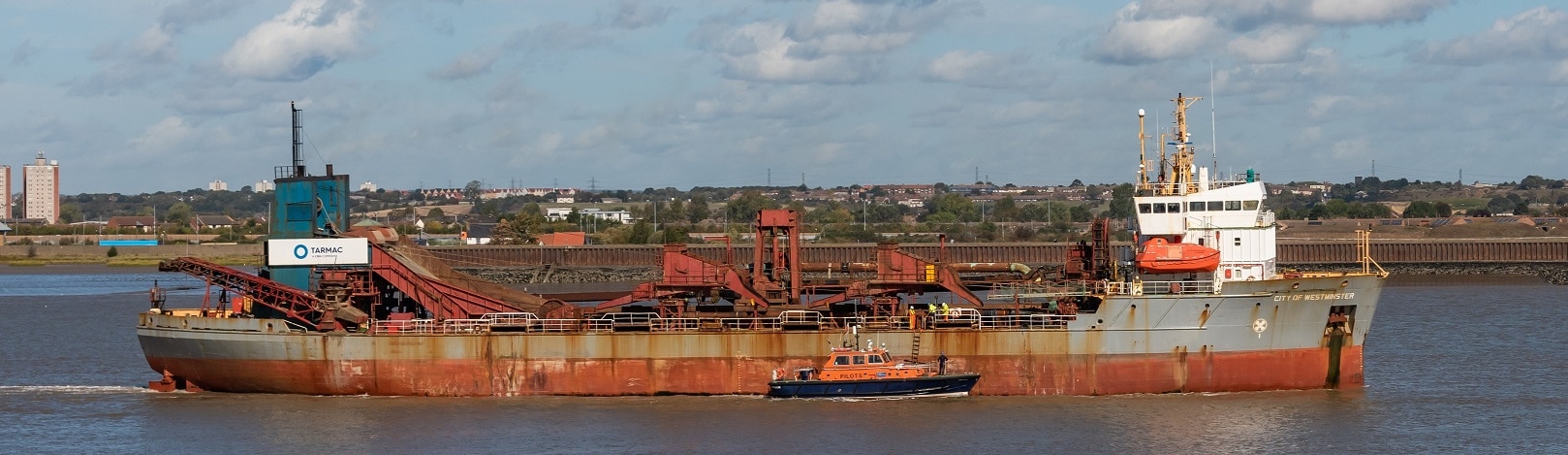
The Port of London (PLA) Hydrographic department recently teamed up with Unmanned Survey Solutions (USS) to provide ground-breaking educational support to University College London’s (UCL) IHO CAT A course in Hydrographic Surveying.
The PLA have supported the University for many years by providing lectures in current Hydrographic techniques and equipment as well as supporting their student field projects. However, due to COVID-19 restrictions, the final element of this year’s support had to be conducted virtually. The PLA, in conjunction with the USS and UCL, devised a two-week schedule which incorporated a combination of manned and unmanned survey tasks to bring the very latest industry solutions to MSc students.
‘Unmanned Surface Vessels (USVs), have a key role to play in the future of surveying’ says John Dillon-Leetch, Port Hydrographer at the Port of London Authority. He went on to say ’With the same sonar system technology as fitted to our larger surveying vessels, Maplin and Thame but at a fraction of the size of the size, this remote unmanned vessel can access areas that weren’t accessible before to this level of survey capability, changing the way we survey the riverbed. It is battery powered so releases no carbon emissions and is robust enough to work in rough offshore and coastal conditions.’
Using remote access capability to onboard systems, students from as far away as China, Saudi Arabia, and Singapore received daily interactive broadcasts from the Hydrographic teams aboard the PLA manned vessels M/V Maplin and M/V Thame to direct and participate in the project work. During the final week of operations, they were also able to remotely pilot USS’s Accession 350 Unmanned Surface Vessel (USV) and send it off on pre-programmed survey missions to gather high resolution bathymetry. As future hydrographic surveyors, this was a real insight into how the industry is tackling the challenges which COVID-19 is having on daily survey operations.
Major Contract Win For OTAQ with Unique Maritime Group
World class marine technology company, OTAQ Offshore, has announced a significant contract award and exclusive supply agreement with Unique Group to supply a number of seabed landers.
The Aberdeen based company, a subsidiary of OTAQ PLC, with offices in Lancaster, Ulverston and Puerto Montt in Chile, will design and build the observation platforms in collaboration with Unique Group.
Commonly used to record physical, chemical and biological activity, OTAQ Offshore will fit the seabed lander systems with inspection products, such as very high-resolution stills cameras, Eagle IP video cameras, OceanSENSE leak detection system and Dragonfish laser measurement systems. The systems will also be configured to carry other third-party supplied inspection and monitoring equipment.
Two models are in line to be produced; a shallow-water version rated to 300m and a deep-water version rated to 4000 metres, available for rental and sale exclusively through Unique Group’s worldwide office network. Independently owned with global reach, Unique Group leads the way in providing engineering, expertise, sales and rental equipment, as well as the developing and implementing the latest technology for the marine, diving, pipeline and subsea market sectors. The two models will allow clients to use the landers in a range of applications using their existing cables and winches.
Phil Newby, Chief Executive Officer, OTAQ plc said: “We are thrilled Unique Group chose OTAQ Offshore to support them with this project. We have an exceptional team of engineers, whose skills are uniquely suited to this type of activity. Having Unique Group as our exclusive partner for sales and rentals will open new doors for us, as well as strengthen our position as a world class marine technology company.”
Chief Operating Officer at Unique Group, Sahil Gandhi, said: “We are excited to be able to further our partnership with OTAQ Offshore by collaborating on the development of seabed landers. Through this launch, we reiterate our commitment to offering exceptional products and solutions to our customers globally, and look forward to future innovations with OTAQ.”
Unique’s 500 strong team work worldwide through Unique Group’s six multi-site divisions; Survey Equipment, Autonomous Survey Vessels, Marine & Subsea, Diving & Life Support, Buoyancy & Ballast and Medical Technology.
For further information please visit www.otaq.com.
ROMOR Ocean Solutions unveils two NEW Wave Gliders for Dalhousie University
ROMOR Ocean Solutions has announced the arrival of two new Liquid Robotics Wave Gliders for Dalhousie University in Nova Scotia, Canada.
The two gliders are an addition to the suite of ocean monitoring tool used by Dalhousie-based Ocean Tracking Network (OTN), the Ocean Frontier Institute (OFI) and the Marine Environmental Observation Prediction and Response (MEOPAR) network. These two new vehicles will be used to support critical marine research in the Northwest Atlantic and will be housed at the Centre for Ocean Ventures and Entrepreneurship (COVE) in Dartmouth, NS. Dalhousie, under the auspices of the Coastal Environmental Observation Technology and Research (CEOTR) group, operates the largest glider monitoring program in Canada.
“Liquid Robotics has worked with ROMOR to deliver Wave Gliders to Canadian research institutes like the team at Dalhousie University for a number of years, but this year presented some unexpected challenges, as we all know,” said Jimmy Board, Senior Manager of Business Development at Liquid Robotics. “Darrin’s understanding of the Canadian market has always been impressive and extremely valuable. This year he went above and beyond, navigating the challenges of 2020 to make sure we could deliver for the customer, and culminating in the delivery of new SV3 v300 Wave Gliders to expand our footprint in Canada.”
The gliders—also known as marine autonomous vehicles— exploit the difference between wave energy at the surface and the energy at depth to generate forward propulsion. Equipped with solar panels and satellite communications, these gliders can recharge, reposition and relay critical information for months at time.
“ROMOR is delighted to see the latest in Wave Glider technology joining OTN’s fleet at the Cove. Two years of project work with the team at Dalhousie’s CEOTR glider team with Liquid Robotics has led to some innovative developments, including customized integration for the Wave Glider by Liquid Robotics and the development of a CTD profiling winch. We look forward to continued involvement on this exciting project,” says Darrin Verge, CEO of ROMOR Ocean Solutions.
These two new vehicles will be used to support Dalhousie University glider operations under the Development of Autonomous Marine Observation Systems (DAMOS) program, funded by the Canada Foundation for Innovation and OFI. The vehicles will be used in the Northwest Atlantic Ocean to support CEOTR by offloading data from bottom-mounted acoustic receivers that listen for acoustically tagged animals. The gliders can also detect tagged animals, such as snow crab and lobster, and routinely patrol the Scotian Shelf monitoring for these animals to help researchers gain knowledge about the movements and life histories of these commercially important species. During these missions, the gliders collect meteorological and oceanographic data that are made available to stakeholders across industry and research sectors.
ROMOR congratulates Dalhousie University for continuing its leadership role in the deployment of ocean technology for innovative ocean research. A huge thanks goes out to the team at Liquid Robotics for designing a great product and providing superior technical support. This is another big win for the ocean technology industry in Atlantic Canada.
More info: romor.ca