
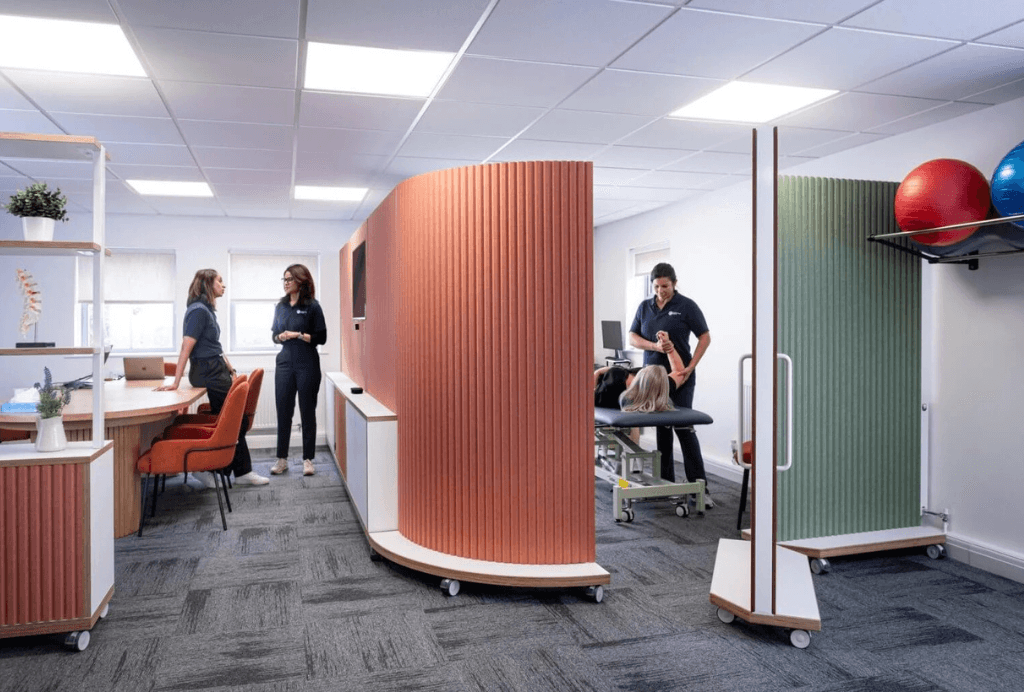
When Healing Touch set out to create its own dedicated therapy centre, the ambition went beyond simply fitting out a space. The goal was to design an environment that felt welcoming, adaptable and far removed from the clinical settings often associated with rehabilitation.
The challenge lay in the nature of the space itself. An open-plan layout offered potential, but it also needed to be carefully divided into smaller, functional areas—without compromising accessibility, flexibility or the overall sense of calm. Traditional partitioning solutions, such as fixed walls or glass systems, presented limitations. They are often costly, permanent and restrictive, particularly for organisations that may need to evolve or relocate over time.
Working alongside interior designer Maria Hatton of Hattons, the team explored alternative approaches that could better support the dynamic nature of therapy environments. The answer came in the form of ThinkingWall by Logo Visual, a modular system more commonly found in workplace and education settings.
At its core, ThinkingWall offered something fundamentally different: flexibility without compromise. Freestanding and fully reconfigurable, the system allowed the team to create temporary rooms, define zones and introduce acoustic separation, all without the need for permanent structural changes.
This adaptability quickly became central to how the space functioned. In the children’s therapy area, for example, modular units were arranged to create multiple treatment zones, allowing several patients to be seen simultaneously without distraction. At other times, those same units could be moved aside to open up the space for group sessions or staff training, demonstrating a level of versatility that traditional fit-outs rarely achieve.
Equally important was the atmosphere. Rather than feeling clinical or segmented, the space maintains a sense of openness and warmth. The modular units soften sound, introduce texture and contribute to a more human-centred environment, something that is critical in spaces focused on wellbeing and recovery.
The project also highlighted the value of collaboration and customisation. While ThinkingWall provided the foundation, certain elements required tailoring to meet specific needs. One such example was the introduction of a bespoke door unit, designed in partnership with the ThinkingWall team to create fully private consultation rooms. Details such as integrated storage, shelving and AV elements were also incorporated, ensuring the system supported both practical and therapeutic requirements.
Because the units are manufactured with flexibility in mind, they could be adapted in size, configuration and finish—allowing the final space to align closely with Healing Touch’s identity and day-to-day operations.
The end result is a highly functional, future-ready environment that supports both patients and practitioners. Private consultation rooms, adaptable therapy zones and multi-use spaces coexist within a layout that can continue to evolve over time. Crucially, all of this has been achieved without permanent alterations to the building, meaning the organisation retains the freedom to adapt or relocate as needed.
More broadly, the project demonstrates how modular thinking is beginning to extend beyond its traditional applications. Solutions once associated primarily with offices are now finding relevance in more sensitive, human-focused environments—where flexibility, comfort and adaptability are just as important as performance.
In bringing ThinkingWall into a healthcare setting, this project offers a compelling example of how design innovation can respond to real-world challenges—creating spaces that are not only practical, but genuinely supportive of the people who use them.