
Seeing the Waves Before They Hit: The AI Innovation Shaping Offshore Safety
Imagine if offshore crews could anticipate every critical wave before it arrived, adjusting operations in real-time to maximize safety and efficiency. What once seemed like a futuristic dream is now becoming a reality with cutting-edge wave prediction technology. For decades, the offshore industry has relied on weather forecasts and experience navigating unpredictable seas. But today, thanks to advances in artificial intelligence (AI) and real-time data analytics, we stand on the brink of a technological revolution that could redefine how we operate at sea.
Wave prediction has long been a sought-after advancement in sea state monitoring, particularly within offshore operations. Companies eager to enhance operational efficiency and safety have long awaited its development and practical integration. Today, while wave prediction technology is still evolving, significant progress has been made, positioning it as a game-changer for offshore operations.
Two Approaches to Wave Prediction – Can We Predict the Unpredictable?
Wave prediction technology falls into two main categories: statistical and deterministic. Statistical prediction uses real-time data to estimate wave conditions and heights over extended periods, ranging from minutes to days. Deterministic prediction, on the other hand, leverages artificial intelligence (AI) and advanced analytics, combined with radar data, to monitor sea states and anticipate specific wave impacts within seconds to minutes. This technology alerts offshore crews to imminent wave events, allowing for better preparedness and response.
Enhancing Dynamic Positioning and Operational Decision-Making
When integrated with dynamic positioning (DP) systems, wave prediction technology has the potential to revolutionize offshore operations. DP systems, crucial in offshore activities since the 1960s, could benefit from real-time deterministic wave prediction that enables automatic adjustments in response to incoming waves—similar to the role of wind sensors today.
However, before full reliance on this technology, operators must thoroughly understand its capabilities and reliability. A key intermediate step is refining DP consequence analysis, where localized sea-state data enhances estimations of environmental forces acting on vessels. This allows for more precise risk assessments and informed operational decisions, such as adjusting thruster power, repositioning vessels, or postponing activities.
Breaking Barriers: Overcoming Technological Challenges
Despite recent advancements, some skepticism remains regarding the consistency and reliability of deterministic wave prediction in complex offshore environments. Traditional methods have struggled with challenges such as multimodal sea states, nonlinear ocean wave behavior, and limitations in radar installation configurations.
Additionally, the correlation between sea surface data and vessel motion has been difficult to accurately model.
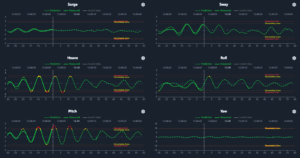
In response, Miros has developed a next-generation wave prediction system, PredictifAI®, which integrates multiple radar sources, AI-driven algorithms, and adaptive analytics. This system automatically adjusts to varying sea conditions, overcoming previous limitations and significantly improving predictive accuracy. By collecting and analyzing extensive real-world data, PredictifAI technology delivers precise predictions of sea surface heights and vessel motion, enhancing offshore safety and operational efficiency.
Why PredictifAI is a Game-Changer
Employing a combination of marine X-band navigation radar, at least one down-looking radar such as the Miros RangeFinder, and multiple motion sensors. A dedicated processing unit interprets data from these sources, with results displayed on a user-friendly, configurable graphical interface.
The system utilizes both established scientific models and AI-driven adaptive algorithms to fine-tune predictions in real-time. Performance is continuously assessed by comparing predicted outcomes with actual measurements. PredictifAI has demonstrated high correlation coefficients—typically around 0.9 or higher—between predicted and observed wave motion, with minimal root-mean-square (RMS) deviation.
Customization is a core feature of PredictifAI. The system can be tailored with different radar and sensor configurations, varied data inputs, and adaptable operational limits. The graphical user interface (GUI) further enhances usability by providing real-time insights, including uncertainty zones and system reliability indicators. For fixed offshore installations, the system offers sea surface height and air gap predictions without motion modeling.
Tested and Proven: What Does Real-World Validation Say?
During its development phase, PredictifAI technology underwent extensive field testing in diverse offshore environments, including a pilot program on a North Sea construction vessel. This real-world testing enabled continuous refinement of the system, with data being transmitted to Miros Cloud for further analysis and optimization. The result is a robust, reliable tool that empowers offshore teams with real-time wave predictions, ensuring safer and more efficient operations.
Advancing Offshore Operations with Cutting-Edge Innovation: Are You Ready to Stay Ahead of the Wave?
Radar technology has long played a crucial role in measuring sea states and currents. However, the advent of deterministic wave and motion prediction represents a major leap forward. By combining traditional measurement techniques with AI-enhanced analytics, PredictifAI delivers a flexible, high-performance solution that adapts to evolving offshore conditions.
For 40 years, Miros has led ocean technology innovation, pushing boundaries to enhance offshore safety and efficiency. PredictifAI turns a long-held vision into reality, transforming what once seemed like science fiction into a market-ready solution. This breakthrough reaffirms Miros’ commitment to pioneering the future of offshore operations.