
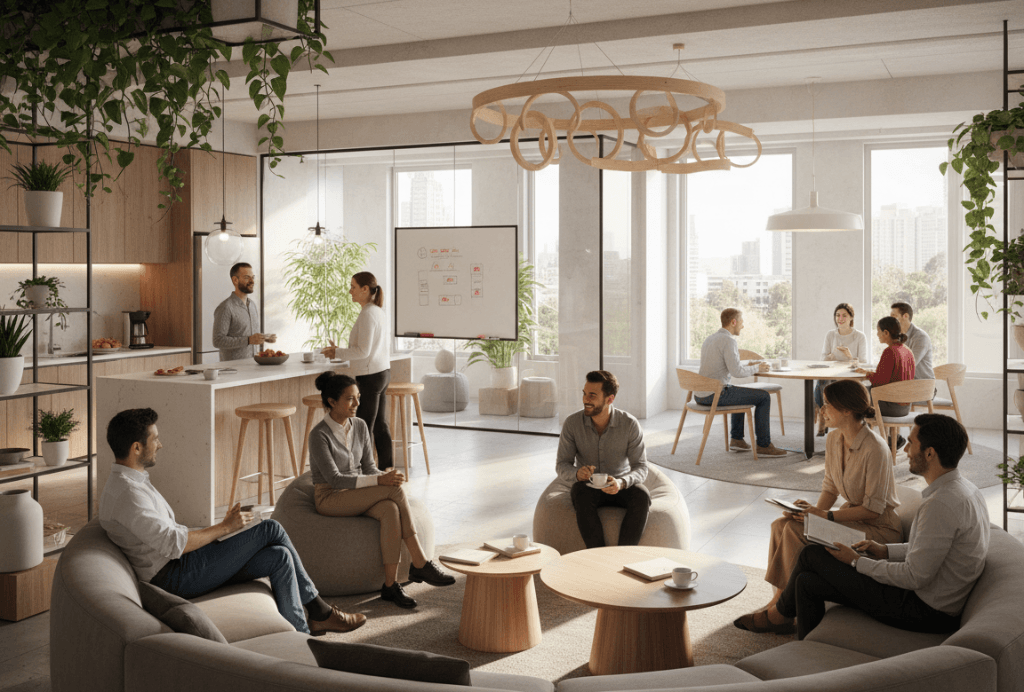
There is a particular kind of silence that settles over a well-designed office at 11am on a Tuesday when no one comes.
The furniture is right. The light is considered. The coffee is good. And yet something essential is missing – not from the space, but from the experience of it. The building is open. The community, somewhere along the way, quietly closed.
This is the tension sitting at the centre of workplace design right now. Not the familiar debate about how many days a week people should be in the office, or whether the open plan is finally dead. Something more fundamental: the growing realisation that the environments we design, however sophisticated, are only ever infrastructure. What they are meant to carry is something architects cannot specify on a drawing and occupiers cannot mandate in a policy.
What they are meant to carry is belonging.
The organisations asking the sharpest questions today are not asking how to fill their buildings. They are asking how to rebuild the connective tissue of their cultures and whether the spaces they commission are actually designed to help with that at all.
The Infrastructure We Actually Need
Ask someone what they value most about being in a shared space with colleagues and the answers converge quickly. The informal conversation, the hallway collision, the lunch that turned into a breakthrough. The texture of daily belonging. The sense of being part of something larger than a calendar of back to back meetings.
This is not a facilities problem. It is a design problem of a different order entirely.
Architects and designers have long understood that space shapes behaviour. Light, volume, threshold, materiality. The built environment is never neutral. What this moment is demanding is an extension of that same rigour into territory that blueprints cannot fully capture: the social infrastructure of organisations.
Because here is what occupiers are quietly grappling with. People returned to beautifully designed spaces and found them curiously hollow. The problem was not the design of the room. It was the absence of designed belonging.
Physical and Digital Are Not in Competition
One of the more unhelpful framings in workplace strategy has been the positioning of physical versus digital, as though the future of work requires us to choose a side. It does not. It requires us to understand that physical and digital are now two layers of the same infrastructure, and both need to be intentionally designed.
A workspace without a considered digital layer is incomplete. The relationships that sustain organisations do not pause at 6pm or exist only within a postcode. They run through shared channels, asynchronous conversations, virtual rituals and digital touchpoints that either reinforce a sense of community or quietly erode it. Most organisations have invested heavily in the physical layer and left the digital one to chance.
The inverse is equally true. Digital tools alone cannot carry the full weight of human connection. There are things that still require physical co-presence. The moment of genuine trust, the non-verbal negotiation, the experience of sharing a room and a problem simultaneously. Good spatial design creates the conditions for those moments. It does not guarantee them, but it makes them more possible.
The organisations doing this well are not asking “office or remote?” They are asking: what does our community need, and what combination of environments, physical and digital, will actually deliver it?
Belonging Is a Design Brief
For architects, designers and occupiers, this shift carries a practical implication worth sitting with.
The brief has changed.
It is no longer sufficient to design a space that functions well, that optimises for adjacency, supports focused work, ticks the wellness credentials. Those remain necessary conditions, but they are no longer sufficient ones. The deeper question being asked of every environment now is: does this space make people feel they belong here?
Belonging is not a soft metric. It directly predicts retention, contribution, psychological safety and organisational resilience. And crucially, it does not emerge from amenity or aesthetics alone. It emerges from repeated experiences of genuine connection, the sense of being seen, heard and part of something that has meaning beyond the transaction of employment.
Designing for that requires architects and designers to think alongside organisational behaviourists, community strategists and the occupiers themselves. It requires occupiers to see space not as a backdrop but as an active participant in culture building. And it requires all of them to ask harder questions about trust, participation and ritual, the less tangible but entirely real architecture of community life.
The Valuation Has Shifted
There was a time when a company’s most valuable real estate was measured in location, lease terms and square footage. That calculus has not disappeared, but it has been joined by something else entirely.
The most valuable real estate an organisation occupies today is relational. It lives in the quality of its connections, the depth of its shared experience, the strength of the networks that hold people together across physical distance and digital noise.
The workplace is no longer anchored to a building. It has become a network of people, relationships, environments and shared moments, woven across physical space and digital layers alike. Community is no longer the byproduct of putting people in the same room. It is the thing organisations must now actively and intentionally build.
The spaces we design, whether laid in concrete or written in code, are only as powerful as the community they are built to serve. Fostering belonging, trust, participation and genuine connection is no longer the soft work that sits alongside the real brief.
It is the real brief.