
How CMS GeoScience overcomes the challenges of working in busy ports
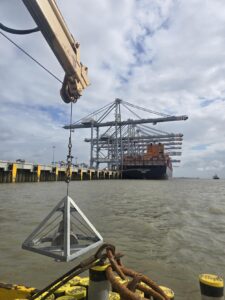 CMS GeoScience is proud to announce the recent work we completed as part of the expansion of one of the UK’s busiest container terminals, DP World London Gateway.
We undertook a geotechnical survey for the Port of London Authority (PLA) and DP World London Gateway. Work was carried out across three days in September on the project’s Berths 5 and 6 to acquire essential environmental and geotechnical data for regulatory compliance and project design.
“The Port Of London Hydrographic Service chartered CMS Geoscience‘s MV Flatholm as a turn-key solution platform to complete a coring and sampling campaign at 21 sites for our client at London Gateway, Thameshaven,” said Jim Powell, Hydrographic Operations Manager at PLA.
The nature and location of the site meant several logistical and safety challenges needed to be overcome. Tide and weather played a big part. Specific time constraints meant the job had a specific window and a tight deadline.
The survey site was located directly opposite Berth 4, an active and busy container terminal. Our team had to operate with strict adherence to PLA navigational controls and exclusion zones, while continuously coordinating with the port’s vessel traffic services. The PLA supported our work with planned vessel movements to allow team to work around marine traffic.
It was essential to design a sampling campaign that could accurately delineate potential hotspots for regulatory bodies. To add to this, the survey had to account for the potential of residual UXO, and strict adherence to our UXO encounter procedures onboard.
This dynamic and high-risk environment demanded not just technical expertise, but a strong commitment to operational safety.
Our team, operating from the MV FlatHolm, executed a meticulously planned vibrocore sampling campaign over three days. We acquired 21 vibrocore samples and 21 surface grab samples, as well as over 160 sets of sub samples, gathering the necessary geotechnical and environmental data to inform the project.
As with every project we work on at CMS GeoScience, the work was carried out with exacting precision, with every sample handled under rigorous protocols, fully documented, and stored in line with MMO/CEFAS standards. Our daily chain-of-custody transfer ensured the integrity of every single sub-sample.
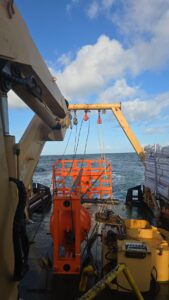 We maintained continuous communication with port operations, navigating the heavy marine traffic and tidal constraints with seamless coordination. Working closely with the PLA ensured that all project objectives were met safely and efficiently.
We also worked with the PLA on logistics to arrange moorings, the collection of sample containers, the delivery of samples each day, adherence to chain of custody, so a big thanks goes to them.
“Throughout, CMS were flexible and adaptable to changing weather windows enabling a timely mobilisation to the Thames within a narrow weather window to execute the works on time and to budget,” added Jim Powell.
“Great collaborative attitude from the office and field teams made for a smooth operation and we look forward to working with you again in the future.”
We were able to adjust our schedule to complete work at the critical time. We managed to mitigate downtime by working with the PLA to ensure vessel time was optimised, which also reduced costs. We’re happy to report that the project was a success.
We acquired all vibrocore and grab samples across Berths 5 and 6. This data will be critical in ensuring compliance with both PLA and MMO regulations, providing the assurance needed for the client’s project to move forward.
Most importantly, the entire operation was completed incident-free, testament to our team’s ability to deliver crucial data with the highest standards of safety, professionalism, and integrity, even in challenging marine environments.