
Listening with less noise: How uncrewed vessels can support marine mammal research
In marine mammal monitoring, every acoustic trace can help researchers understand where animals are moving and how populations are changing. Collecting those traces, however, is not simply a matter of putting a hydrophone in the water. The survey platform itself can become part of the problem.
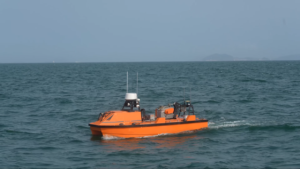
In April 2022, researchers working in a protected coastal area in southern China used an OceanAlpha M40P uncrewed surface vessel (USV) with passive acoustic monitoring equipment to investigate the local Chinese white dolphin population and distribution. The project showed how a quieter, compact surface platform can improve the conditions for marine-mammal monitoring while also making the field operation easier to manage.
A sensitive species in a busy estuary
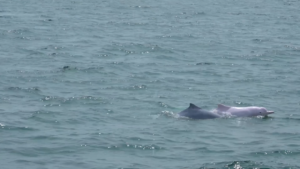
The Chinese white dolphin, also known as the Indo-Pacific humpback dolphin (Sousa chinensis), is listed as Vulnerable on the IUCN Red List. The Pearl River Estuary supports a major population, but it is also one of the world’s most intensively used coastal environments. Effective protection depends on reliable observations of where dolphins occur, how groups are distributed and whether younger animals are present.
Visual observations remain important, but sound gives researchers another way to detect dolphin activity. Passive acoustic monitoring records vocalisations without transmitting sound into the water. Each useful recording can contribute evidence on the presence and movement of animals, including when visibility makes direct observation difficult.
Why the survey platform matters
Conventional fishing boats had previously been used for local dolphin research. Their machinery and hull noise could interfere with acoustic measurements, so hydrophones were commonly towed on cables up to 80 metres long to increase the distance between the sensor and the vessel. A long tow cable creates its own operational challenges: deployment and recovery take more effort, and the instrument is exposed to greater risk of snagging or damage.
For this mission, the electrically propelled M40P followed a planned route through the reserve while towing the acoustic equipment astern. Its lower operating noise provided a quieter working environment for the sensor. The tow cable could be shortened to around 10 metres, simplifying handling and helping protect the equipment.
The catamaran platform also offered a stable base for the payload. Rather than treating the USV as a stand-alone product, the project combined the vessel, acoustic sensor, route planning and remote supervision into one data-collection workflow. That integration is essential: a quiet hull is useful only when the sensor arrangement, operating speed and survey route are designed around the scientific objective.
Turning sound into evidence
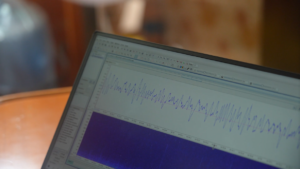
The recorded signals gave the research team material for analysing dolphin activity in the reserve. Chen Yuwei, an engineer with the Institute of Hydrobiology of the Chinese Academy of Sciences, explained the value of the data: “Every voice track represents a Chinese white dolphin. We have successfully applied sonar devices and acoustic technologies to our population and distribution research.”
The mission also produced encouraging field observations. Chen Xi, then head of the technology department at the Pearl River Estuary Chinese White Dolphin National Nature Reserve, noted that many of the dolphins observed in the area were young, including calves. Such observations do not replace long-term population analysis, but they add valuable context to the acoustic record and help guide continued monitoring.
Beyond a single research mission
The same reserve also used an autonomous surveillance and rescue vessel for routine patrols along predefined routes. Radar and Automatic Identification System data supported real-time monitoring of vessel traffic, recording tracks and flagging potentially suspicious activity. This illustrates a broader role for uncrewed platforms in protected waters: the technology can support both scientific observation and day-to-day stewardship.
Not every marine-mammal survey is suited to a USV. Weather, sea state, communications coverage, local traffic, sensor requirements and wildlife-disturbance protocols all need to be considered. Researchers must also validate data quality and retain clear control over mission changes or termination. Uncrewed operation changes where people work; it does not remove the need for experienced scientists, surveyors and mariners.
The Pearl River Estuary project nevertheless offers a practical lesson for ocean observation. When the platform is selected around the measurement rather than the other way round, autonomy can do more than reduce the number of people at sea. It can create better conditions for the sensor, make delicate equipment easier to handle and help researchers listen to protected species with less interference.
For marine science, that may be one of the most useful measures of technology: not how visible it is in the field, but how quietly it helps the evidence come through.
About OceanAlpha
OceanAlpha develops uncrewed surface vessel systems for hydrographic survey, environmental monitoring, marine engineering, security and rescue. Its work focuses on integrating vessels, sensors, autonomy and remote control into practical marine operations.