
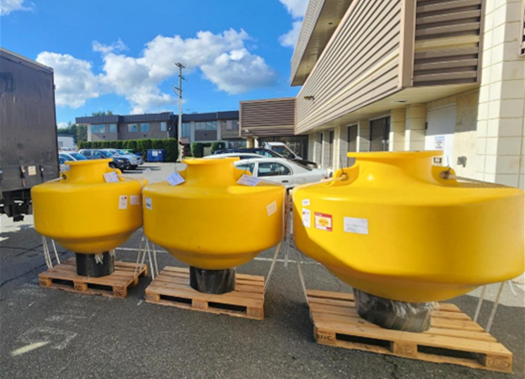
ASL floating new wave measurement opportunities
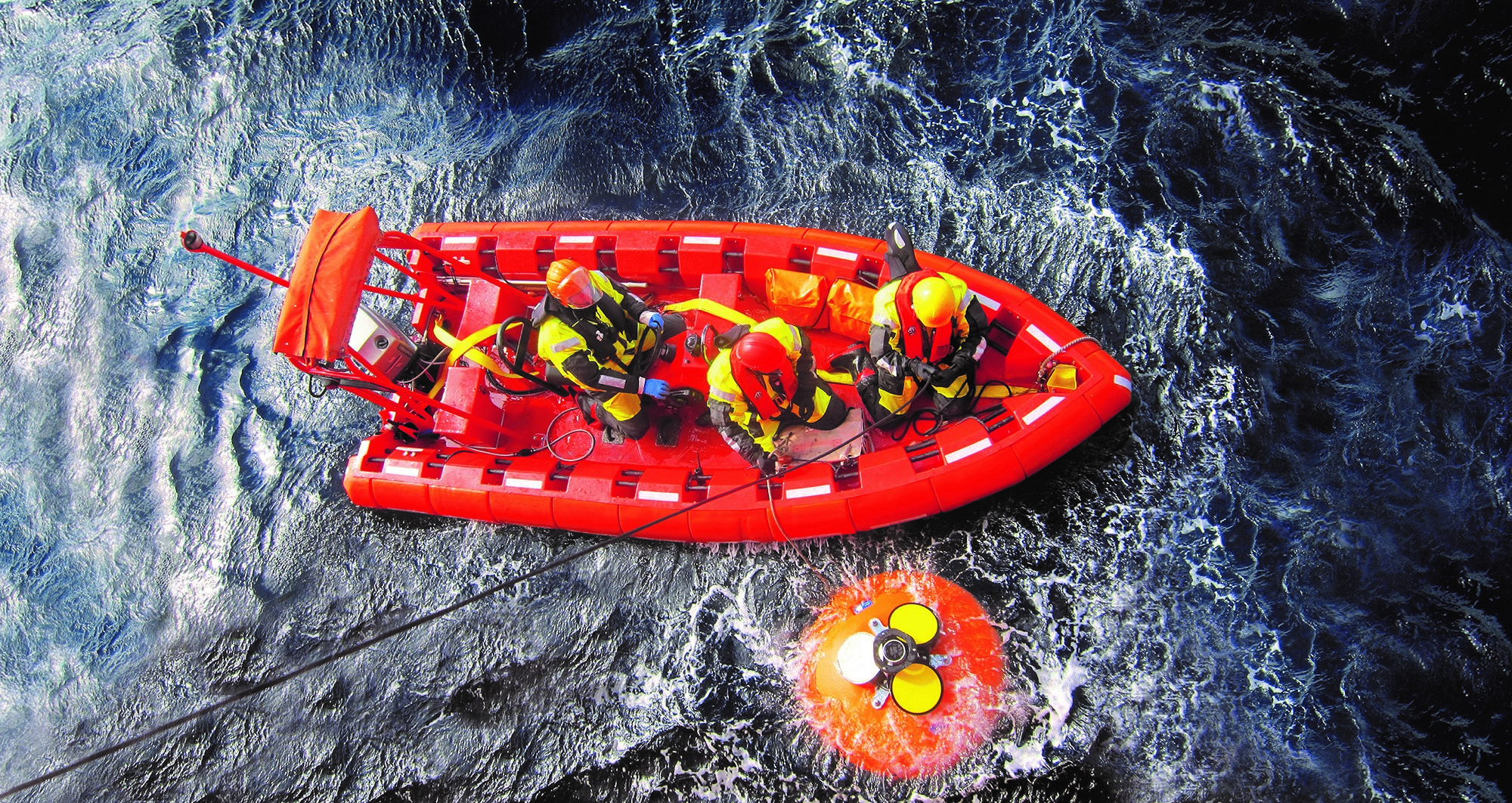
ASL is pleased to announce that it has recently acquired three Mesemar PBM-15 Polyethylene buoys for a major metocean study we are undertaking for a client project. These buoys are designed to the International Association of Marine Aids to Navigation and Lighthouse Authorities (IALA) recommendations and are made from high-quality rotomoulded virgin polyethylene, filled with closed-cell expanded polyurethane foam. These are very suitable for deep-water sites where extreme weather requires a more robust buoy for metocean data collection. They feature the ability to add an internal ballast weight for greater stability and high shock resistance.
Following their successful recovery in the spring of 2024, we plan to add these to our lease pool to offer to future clients, especially for measuring directional waves in offshore environments to support the development of offshore wind farms and other marine renewable energy projects where stable, reliable data collection over extended periods is required.
The PBM-15 provides a robust platform suited to harsh conditions offshore or a stable platform in more protected waterways. This platform can easily be configured to meet client monitoring needs and client-customized instrument packages. These buoys are intended to expand our existing shallow-water wave monitoring services to include deep-water directional wave studies for site assessment, numerical modeling studies, engineering design criteria and extremal analysis, and other applications. Examples of data collection include, but are not limited to, directional waves, wind, barometric pressure, and custom solutions.
Ferd invests in ocean technology group General Oceans
Ferd, a family-owned investment company, has acquired a 25 percent stake in the ocean technology group General Oceans. Following several acquisitions in recent years, General Oceans now consists of five world-leading companies covering key areas of ocean technology.
"With Ferd as a strategic owner, we have secured funding for further acquisitions as well as expertise to further develop the companies we acquire. Ocean technology is a fast-growing industry, but it is also fragmented. This requires consolidation, something General Oceans will continue to contribute to", says Atle Lohrmann, CEO of General Oceans.
Ferd will also be represented on General Ocean's board, including through Torfinn Kildal, who has a background as CEO of Kongsberg Maritime and extensive experience from international industry.
"General Oceans manages technology that helps us understand and preserve the world’s oceans. The investment therefore fits very well into our portfolio. We are looking forward to building on the strong positions General Oceans already has within ocean technology globally", says Gustav Martinsen, Investment Professional at Ferd Capital.
Ferd invests in General Oceans through a private placement of NOK 230 million. In addition, Ferd acquires shares from several smaller shareholders. In total, the ownership share will be 25 per cent, but the parties have an ambition that this will eventually be increased to 34 per cent. Atle Lohrmann will still control 56 percent of General Oceans after the transaction.
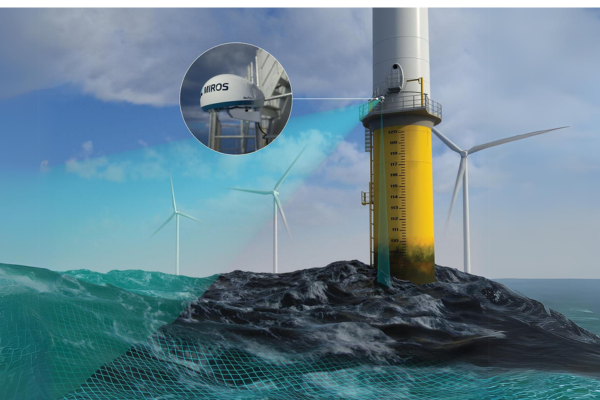
A breakthrough year for digitalisation in the offshore sector
When Marius Five Aarset became Miros Chief Executive at the start of 2023, he set out three key aims for the year for the global oceans insights experts to work towards. To develop the company into renewables and support the acceleration towards net zero goals; to further boost Miros’ cloud technology and modern as-a-service business model; and to translate accurate measurements of the ocean surface into actionable information.
“For the last 12 months, we have been laser-focused on developing our product suite and business models so that they can better help to drive enhancements in the marine and energy sectors, particularly in offshore vessels and offshore wind. We have had great success in this endeavor, and it will continue to be an essential priority for Miros as we move into 2024,” Aarset explains.
“Offshore wind was in the media a great deal in 2023 – some of the coverage positive and some negative – but from our observation there is one point that is clear; the industry is moving. More than ever before developers are more eager to adopt solutions and services for optimizing operations and maintenance. Beyond that, digital business models are now being embraced and appreciated for the value they add across a wide range of industries and regions.”
From vessels and offshore wind projects in Europe to oil and gas operations in Brazil, Miros’ wave and current measurement technology is continuing to inform operations across the world. In 2023 the company experienced solid growth in contracts, going beyond its expectations and across various geographies and markets, as the industry becomes more aware of the value of real-time measurements over forecasts and the benefits of digital business models.
Aarset said: “As an industry we are now at a point where there is established trust in cloud-based technologies, something that is encouraging collaboration between partners. Take our oil spill detection contract with Petrobras in Brazil, which allows offshore data to be securely shared with multiple stakeholders in real-time. Environmental protection is now a major focus for companies, and we have seen demand for Miros’ market leading solutions globally.
“Partners and partnerships are core to Miros’ strategy, right across our value chain from innovation to development to sales, delivery, and customer service. We see customers as our affiliates and this modern, transparent way of working translates into business-led innovation that shapes and drives our technology forward.”
As part of its drive to stay ahead of the curve, or wave, Miros is bringing next generation wave and vessel motion prediction to market, with key offshore customers being early adopters of the technology. It is a technology development that will take shape further in 2024 and, in tandem with this, work is also ongoing to assess vessel behaviors and performance in transit to produce greater real-time insight for safety, efficiency and a more rounded service offering in cooperation with our joint venture Miros Mocean.
Jonas Røstad, Miros Chief Commercial Officer, said: “Unquestionably, 2023 has been a real breakthrough year for the adoption of digitalization in the offshore space, with a real uptake for our as-a-service solution. It is a model that we have been offering and continuously improving since 2018 and companies, especially those that are future-orientated, are recognizing and appreciating the value this brings to their businesses’ bottom line. As part of this, we are closely cooperating with selected customers to help elevate the safety, sustainability, and performance of their maritime operations. We look forward to making an announcement to the maritime industry around this next year.”
On a personal level, the end of the year also offers some time for Aarset to reflect on his journey to date with Miros.
He said: “Miros has a long and proud history, something that is encapsulated by the team’s unique and cooperative way of working. We span a wide range of industries, using Norwegian expertise to service a global market, and that is something I am immensely humbled to be a part of. I am confident that our successes will continue into 2024 when we will also reach a major landmark in the ongoing history of our great company – Miros’ 40th anniversary.”
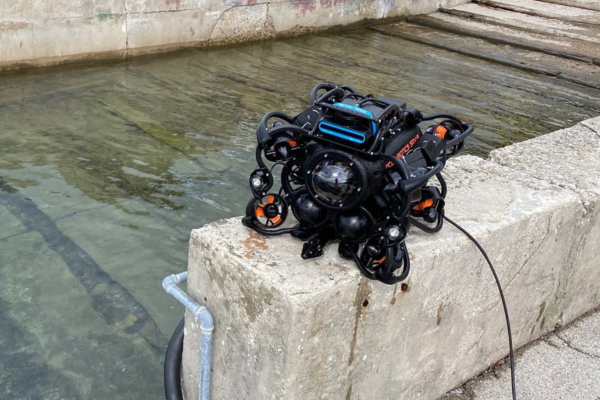
Mexico Port Authorities enhance security with Oceanbotics’ SRV-8 underwater drones
The Mexico Port Authorities have enhanced its port security capabilities by obtaining nine (9) advanced SRV-8 professional underwater drones from Oceanbotics Inc. This strategic move aims to
elevate its surveillance and monitoring capacities, ensuring state-of-the-art technology is deployed across all ports under their jurisdiction.
During the summer, the Oceanbotics support team conducted an immersive, in-person training program for the Mexico Port Authorities. With these drones in operation, professionals are empowered to conduct real-time hull inspections, enhance threat detection measures, and monitor environmental conditions.
As the global landscape transitions towards the widespread adoption of professional underwater drones, this investment positions the Mexico Port Authorities at the forefront of maritime security, setting new industry standards.
L3Harris, Voyis and Wavefront collaborate to enhance NATO Navy’s AUV capabilities
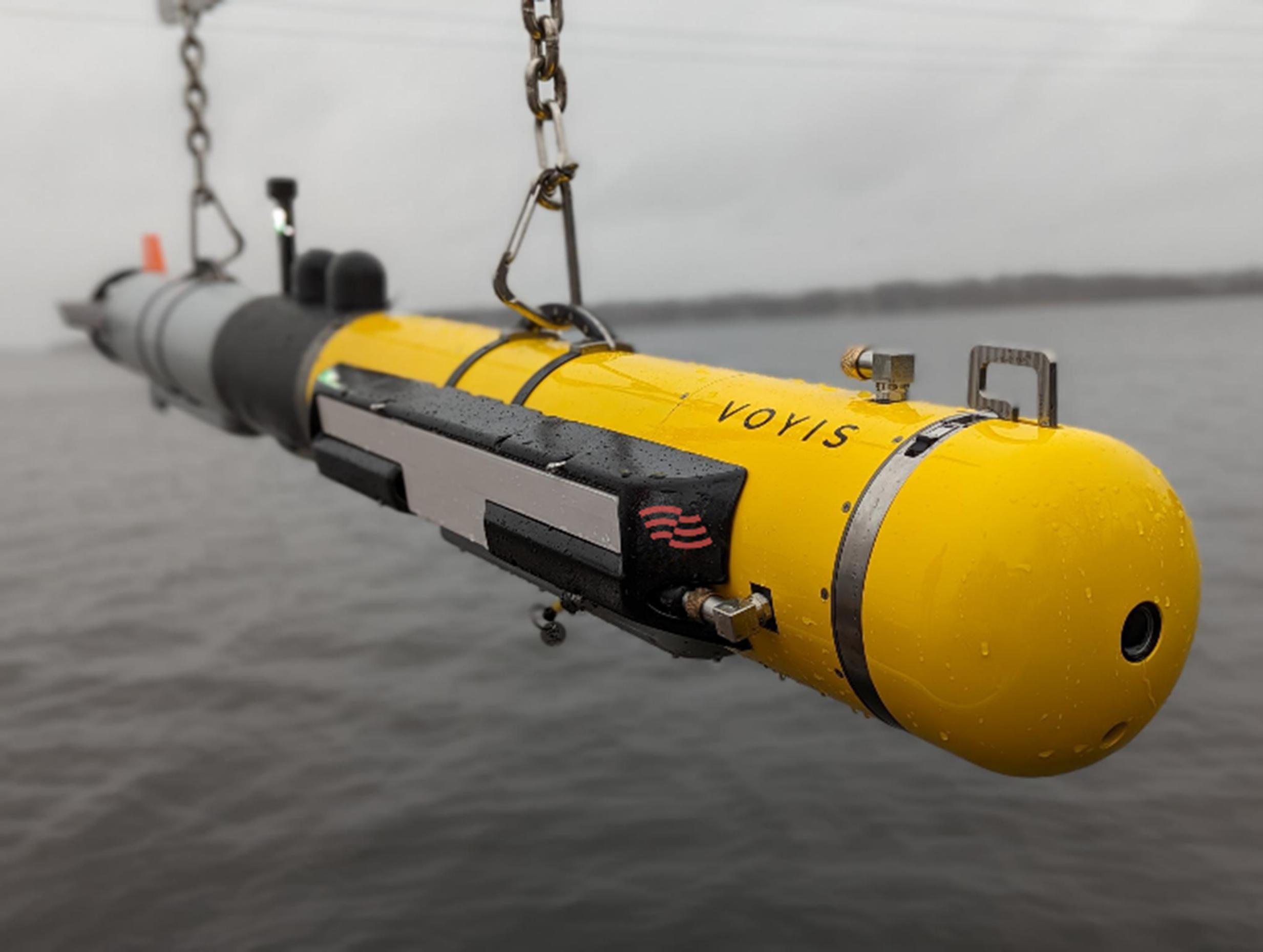
L3Harris, Voyis and Wavefront collaborate to deliver advanced technology to enhance NATO Navy’s autonomous underwater vehicles (AUV) capabilities. L3Harris’ area of expertise is the development of AUVs for a variety of maritime applications. AUVs are designed to operate in harsh environments, including deep water and can be used for a range of missions, including search and rescue, surveillance, mine countermeasures and oceanography. L3Harris is at the forefront of AUV development and continuously advances its technology to meet critical evolving defence mission needs. To further improve L3Harris’ Iver4 900 AUV capabilities, the global defence company integrated a Voyis Recon LS and the Wavefront Solstice 3000 multiple-aperture sonar (MAS) Combined AUV payload onto the Iver4 900 platform to support defence missions.
The Voyis team, in collaboration with Wavefront Systems, is proud to announce a successful factory acceptance test of the Recon LS/3000MAS AUV payload with L3Harris, to be delivered to a NATO Navy, further improving the IVER4 900 capabilities. It consists of a single, integrated forward payload section housing Voyis’ compact dynamic laser scanner, which captures high-resolution 3D point-cloud data, the Voyis’ 4K imaging system with appropriate lighting which captures crisp, evenly illuminated still images with its edge-computed image enhancement feature, and finally, the Wavefront Systems’ Solstice multi-aperture side-scan sonar that delivers 200m-wide swath coverage and bathymetry at high resolution.
The Voyis Recon LS/WaveFront Solstice Combined AUV payload offers a solution for autonomous underwater vehicles to covertly detect, classify, and identify mine-like objects (MLOs), reducing risk to divers. The system uses the multi-aperture side-scan sonar, 4K digital still-camera and high-resolution laser scanner to carry out this task.
The L3Harris’ Iver4 900 vehicle provides the payload with both stability and endurance to make the most of the payload.
MCM operations involve four stages: detection, classification, identification, and disposal/neutralization. Currently, side-scan sonar is used for mine detection and sometimes for classification. However, visual identification requires a clearance diver or remotely operated vehicles to enter the minefield, which is time-consuming and risky, especially in areas with complex seabed. This requires multiple resources to be deployed into a potentially hazardous environment to complete a successful operation, which is inefficient when relying on lower-quality sensor data and dangerous if humans are mobilizing the assets.
The Recon LS/WaveFront Solstice MAS Combined AUV payload is designed to rethink how mine countermeasure (MCM) operations are conducted today and enable single assets to complete complex missions without deploying additional resources within the minefield. By enabling search and classify mapping using Wavefront’s leading multi-aperture sonar Solstice, the vessel can re-acquire and identify MLOs using Voyis’ laser and camera, improving the probability of detection, reducing false alarms, and sustaining a high op tempo.
Voyis and Wavefront partnered with Forcys, a global maritime defence company and a sister company in Covelya Group, to market the system to allied nations.
NASH Maritime launches online marine safety management system, DigiSMS
NASH Maritime, a recognised specialist in port marine safety and compliance, is pleased to announce the launch of its online marine safety management system, DigiSMS.
Under the Port Marine Safety Code, statutory harbour authorities and other marine facilities have a duty to use and maintain a Marine Safety Management System.
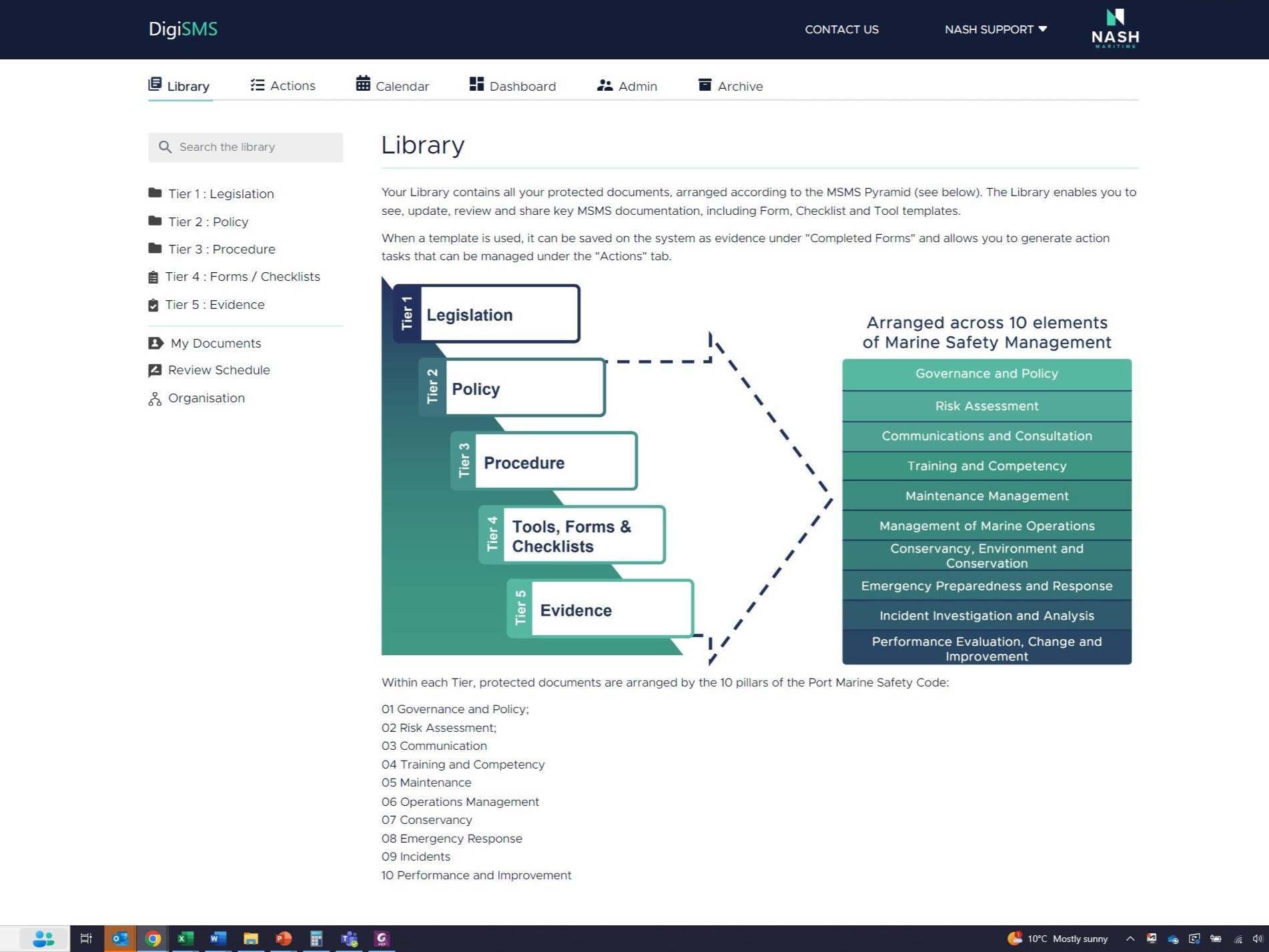
DigiSMS has been specifically designed to reduce the burden of managing and maintaining a Marine Safety Management System. Often policies, procedures, checklists and forms are held in multiple places whereas the new online system brings everything together into an integrated, comprehensive planning and management tool.
Members of NASH Maritime’s Governance and Innovation teams have been working together to make marine safety management simple, efficient and effective. DigiSMS is the product of this collaboration and its development was supported through funding from InnovateUK.
NASH Maritime Co-Founder, Dr Ed Rogers, said,
“We’re really excited by the launch of DigiSMS. In our work supporting port and terminal operators we're regularly told how time-consuming maintaining a Marine Safety Management System can be.
“We listened and understood the difficulties with current in-house systems and designed DigiSMS to make safety management efficient and compliance easily demonstrable.”
With DigiSMS users can:
- Search and share documents,
- Upload completed forms and checklists,
- Manage, schedule and log document reviews,
- Plan marine safety activities with an integrated calendar,
- Assign actions and monitor progress,
- Track compliance metrics, all activity is logged for end-to-end traceability,
- Drive continuous improvement.
The launch of DigiSMS is yet another example of NASH Maritime’s commitment to improving maritime safety through better science, systems and software.
DigiSMS adds to NASH Maritime’s existing portfolio of port compliance services and software.
EdgeTech increases the depth rating on the 2050-DSS combined side scan sonar & sub-bottom profiling system
EdgeTech, the leader in high resolution sonar imaging systems and underwater technology, has increased the standard depth rating to 3,000 meters on all new 2050 combined tri-frequency side scan sonar and high resolution sub-bottom profiling sonar systems.
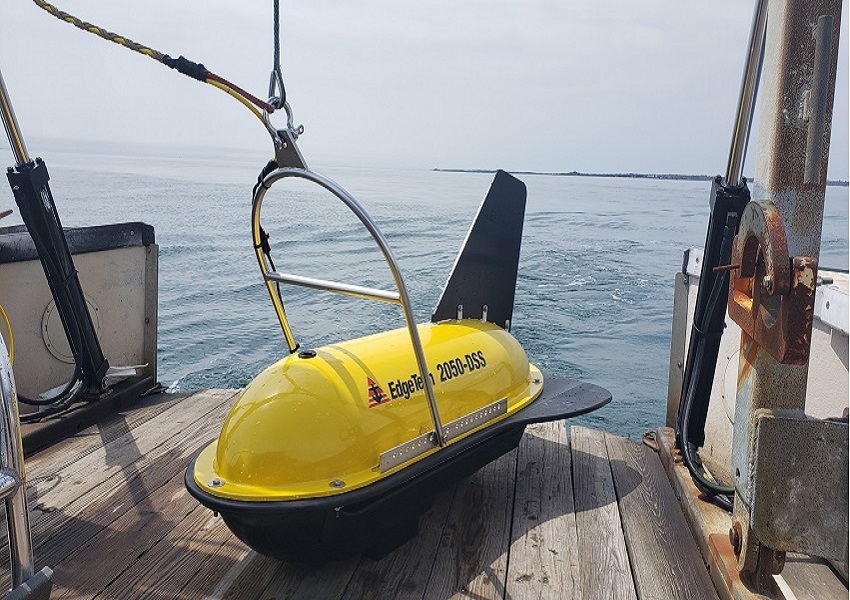
The 2050-DSS is a tri-frequency side scan sonar system, where any two, operator selectable, frequencies can be operated simultaneously. The system can be provided with either a 120, 410 & 850 kHz towfish, or a 230, 540 & 850 kHz towfish. Additionally, both towfish options are equipped with a 2-16 kHz sub-bottom profiler, that utilizes a PVDF panel receive hydrophone.
The 2050-DSS comes complete with a combined towfish, digital telemetry that runs over a single coaxial cable, a 19-inch rack mount topside interface, and EdgeTech’s DISCOVER acquisition software. The 2050-DSS can be integrated with several auxiliary sensors such as magnetometer and USBL responder. Additionally, an interface is fitted to the electronics so that the electronics and sensors can be mounted onto an ROV. The 2050-DSS is ideal for applications such as cable and pipeline surveys, marine construction surveys, pre and post dredging surveys and more. The new increased depth rating enables an even larger scope of applications particularly in relation to the use of the systems on ROVs.
Kraken Robotics awarded seabed survey contract in Australia
Kraken Robotics Inc. is pleased to provide more detail on a recent contract announcement. Kraken will supply high-resolution seabed mapping sonar service to Precision Hydrographic Services (PHS), a customer supporting the Australian Department of Defence. The Australian Department of Defence has awarded PHS a program to collect Hydrographic High Resolution Route Surveys (RS) for a number of Australian ports. The purpose of the RS is to enable the collection of Maritime Geospatial Information (MGI) to support maritime domain awareness through the acquisition of high-resolution seabed foundation data and associated oceanographic data.
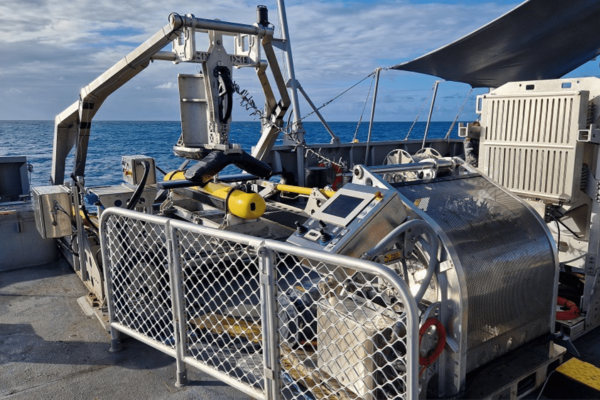
Under the scope of Kraken’s contract, a KATFISH™ high-speed survey/detection solution will be used to acquire high-resolution route surveys of Australian ports. The survey campaign will take place between January and May 2024. This contract follows the results of a successful in-country demonstration of KATFISH™ for the customer in Q1 of this year and the purchase of a KATFISH system by the RAN in Q2.
Repairing coral reefs after damage from climate change
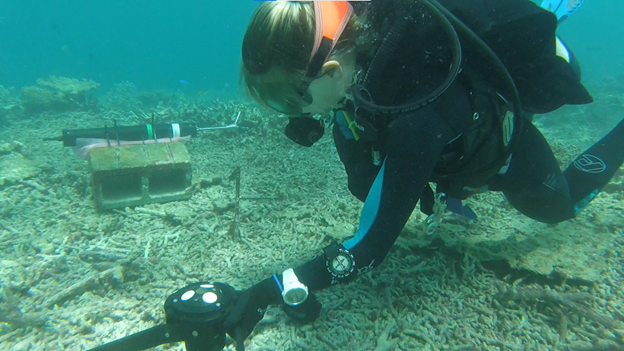
Researchers at the Heron Island Research Station in Australia are using a Nortek velocimeter to determine how much hydrodynamic energy it takes to move around “coral rubble,” the skeletons of corals broken apart by bleaching or storm events in the ocean. Fortunately, researchers have found that stabilizing rubble can be an effective technique for coral reef recovery.
Coral bleaching and storm events can create vast areas of coral rubble on the Great Barrier Reef. If rubble remains in one place for a long time, new, healthy corals can effectively recruit onto it and the reef can recover naturally; but if the rubble is moving around a lot due to waves and currents, new corals living on it can die, hindering recovery. Rubble stabilization interventions can be deployed in areas where the rubble is prone to frequent movement, but we don’t yet know where those areas are.
Investigating energy thresholds for coral rubble movement
“With climate change, we’re going to see more frequent and intense storms and cyclones, as well as coral bleaching events,” says Dr. Tania Kenyon, Postdoctoral Researcher in the Marine Spatial Ecology Lab at the University of Queensland in Australia.
Using a Vector velocimeter designed by Nortek to measure water flow , Dr. Kenyon and other researchers correlated the movement of rubble pieces with flow disturbances to determine how much hydrodynamic energy it takes to move coral rubble.
“What we’re doing with the Vector is looking at rubble mobilization thresholds. We’re using it to monitor the hydrodynamic environment while also looking at the movement of rubble pieces,” Dr. Kenyon explains.
“From previous work I’ve done in the Maldives, we’ve found movement thresholds of about 0.3 to 0.4 m/s. We’re furthering that work now on the southern Great Barrier Reef.”
Working to preserve coral reefs during climate change
“Reefs are very important: millions of people around the world rely on them, they’re important for coastal protection and they’re one of the most biodiverse habitats in the world,” says Dr. Kenyon.
Coral reefs support more species per unit area than any other marine environment and are key to many human development goals, such as supporting sustainable fisheries, discovering new species that can be used in new medicines and bringing in tourism money to support local economies.
Armed with information on what characterizes sites that could benefit from coral rubble stabilization techniques, the team will develop maps of the Great Barrier Reef that show priority areas for such interventions, i.e. areas in the ocean where rubble is moving too frequently for natural coral recovery to occur.
Research in Australia into coral rubble stabilization
Dr. Kenyon is part of the Rubble Stabilisation Subprogram team, comprising scientists from the University of Queensland and Queensland University of Technology, including Dr. Daniel Harris, who is also working on rubble movement and stabilization.
The subprogram is part of the Reef Restoration and Adaptation Program (RRAP) , which has brought together Australia’s leading coral reef experts and is funded by the partnership between the Australian Government’s Reef Trust and the Great Barrier Reef Foundation.
This work will contribute to broader-scale research that identifies areas appropriate for rubble stabilization intervention efforts.
Rubble stabilization techniques include structures that are attached to the substrate to pin rubble down or corral it, including biodegradable meshes, rock piles, rebar grids and structures such as MARS Reef Stars. If rubble is stable for long enough, it can then be naturally bound together by sponges, coralline algae and other marine organisms into a stable surface, like bricks and mortar.
Identifying the best coral restoration techniques for reefs worldwide
While Dr. Kenyon is currently working on the Great Barrier Reef, she is hopeful that the outcomes of this and the other research being done can be used to identify the best coral restoration techniques for reefs worldwide and help reefs navigate the challenges of climate change.
“There is hope for our reefs, if we give them the best fighting chance,” says Dr. Kenyon. “If we bolster their resilience and foster adaptation through various interventions, while also moving to clean energy, we can hopefully hold onto these crucially important ecosystems.”
Greensea IQ demonstrates Autonomous Explosive Ordnance Disposal mission for US Navy and Defense Innovation Unit
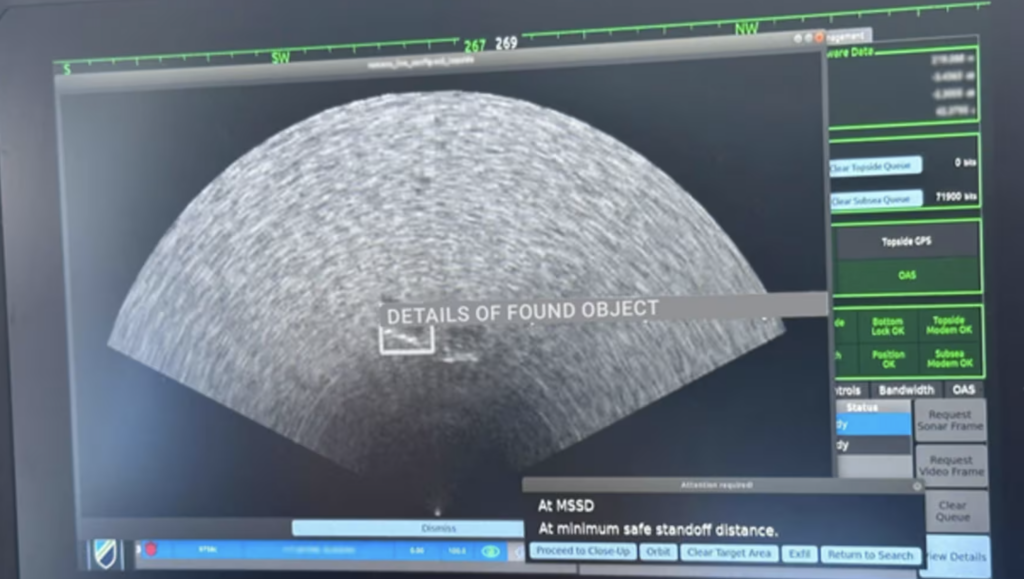
Greensea IQ is the first to successfully complete a demonstration of a prototype Autonomous EOD Maritime Response Vehicle (AEMRV) for the Defense Innovation Unit (DIU) and US Navy. Utilizing the advanced capabilities of OPENSEA Edge, the system provides the computing resources needed to power edge perception systems and advanced autonomous behaviors of EOD Workspace, allowing human-on-the-loop autonomy and untethered command and control over the ROV platform.
The demonstration took place over several days in September in the open ocean off the coast of San Diego, featuring a fully integrated OPENSEA Edge-driven untethered ROV, a VideoRay MSS Defender modified by Greensea IQ to include batteries and an acoustic modem. During the demonstration real world tasks were demonstrated by autonomously searching the environment for threats utilizing acoustic communications.
This groundbreaking demonstration highlighted the autonomy system for EOD Workspace, Greensea IQ's robot agnostic software platform for Mine Countermeasure (MCM) and Explosive Ordnance Disposal (EOD) operations. It also showcased Safe C2, Greensea IQ's communication platform for long-range standoff command and control of autonomous ocean robots, both integrated within the OPENSEA Edge modular, hardware-agnostic system.
Ben Kinnaman, CEO of Greensea IQ, shared his thoughts on the technology "Autonomous intervention technology is the key to increasing our persistence in the ocean, and for making the work we do there safer and more effective. There is no better example of this technology at work than what we have demonstrated to the US Navy and DIU. This software package will make the neutralization of subsea threats safer and scalable using ocean robots.”
Kinnaman went on to say "Working with the Defense Innovation Unit has been amazing. DIU has leaned in hard on finding an urgent solution for subsea threat intervention. This program has combined the rigors of engineering with the possibilities of emerging technologies through a program that is equal parts contracting and venture funding to field a prototype in a very short amount of time."
Greensea IQ has worked under contract with the DIU since 2021 to develop a fully autonomous and untethered software platform for ROVs used in MCM and EOD operations. This exercise was the final demonstration of the successful prototype delivered to the US Navy for further evaluation.