
Seiche wins Ørsted contract to ensure Marine Mammal Safety is of the highest priority during construction of world’s largest offshore wind farm – Hornsea Two
Seiche Ltd’s specialist team of personnel and equipment have mobilised to two key vessels on Ørsted’s Hornsea Two offshore wind farm site. Their purpose is to manage Ørsted’s commitment to ensure impacts to marine mammals during the Hornsea Two wind farm construction activities are negligible.
Specialising in marine mammal monitoring and mitigation measures, the team from Seiche has been brought on board to ensure compliance with procedures that seek to minimise the effects of construction noise on the local marine population. Key species known to occur in the project area are harbour porpoise, white-beaked dolphins, minke whales as well as grey and harbour seals.
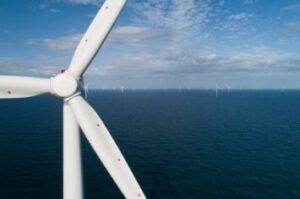 Prior to any construction activities taking place, dedicated Marine Mammal Observers (MMOs) will monitor the area for any animals that could be affected by the noise produced from pile driving.
Monitoring activities are taking place from DEME’s jack-up installation vessels during the installation of 165 monopiles as well as Heerema’s semisubmersible crane vessel Sleipnir during the construction of the 2 offshore substations. In addition to visual monitoring to ensure marine mammals are not within close proximity to piling operations, acoustic deterrent devices (ADDs) are used to deter animals from the area to protect them from harmful levels of noise.
Seiche’s team of observers and ADD Operators ensure that the Marine Mammal Mitigation Plan, which follows the government’s Joint Nature Conservation Committee’s guidance protocol, is adhered to at all times. Should a mammal be detected within the designated protection zone piling operations are delayed until the mammal leaves the area.
Based locally in East Anglia, Seiche’s Associate Director of Environmental Services Nicola Harris said: “As a company we are extremely pleased to be working with Ørsted as well as its contractors DEME and Heerema to ensure that the construction of the world’s largest wind farm can be completed without harming the marine animals off our own coast. Offshore Renewables are key to developing a greener and more sustainable future and we are proud to be working with companies like Ørsted to be a part of that achievement.”
Natalia Lopez, Senior Environment & Consents Specialist for Ørsted said: “We adhere to a strict consenting process before any construction works commence offshore and it’s imperative that outlined procedures are fully adhered to. It’s great to be able to work alongisde UK based suppliers with specialist expertise in this field so that together, we can deliver the world’s largest offshore wind farm in the most sustainable way possible.”
For more information visit:


Forum’s XT500 trenching system to support major cable maintenance project in Asia
Forum Energy Technologies has secured an order to supply specialist subsea equipment for a major cable maintenance project in South East Asia.
The contract, which was awarded through Forum’s local representatives, will see the company deploy a Perry® XT500 trenching system and Dynacon® Launch and Recovery System as well as associated surface power and control installations. The equipment will be used to support telecommunication contracts in South East Asia and the Indian Ocean.
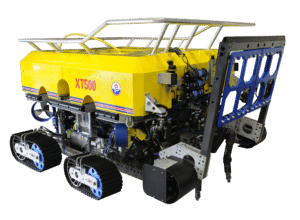
The XT500 trenching system is ideally suited to cable maintenance projects with a 3,000m depth rating and three metre ROV burial capability on the ocean floor. It utilises Forum’s proven Integrated Control Engine (ICE™) and has robust 500 HP power.
The vehicle will be manufactured at Forum’s facility at Kirkbymoorside, Yorkshire and installed onboard the client’s vessel in early 2021. As part of the workscope, Forum will also deliver operational and maintenance training for the client’s personnel and provide support during the first mobilisation onboard the vessel, including sea trials.
Kevin Taylor, Forum’s Vice President - Subsea Vehicles, said: “Forum has a strong reputation globally for manufacturing high quality, robust ROVs and associated auxiliary products for a number of industries ranging from oil and gas to renewables, defence, mining and telecommunications. We have continued to strengthen our footprint in Asia and this contract is a testament to our high-quality equipment and skilled personnel. Our local representative is a well-respected supplier in the region and our partnership has provided a strong channel to complement to our existing framework.
“This is the fifth ROV we have delivered to this client and we are thrilled the organisation continues to see the value our ROVs deliver. I am looking forward to seeing our system provide the required operational resilience, reliability and performance standards expected in such a safety-critical sector.”
The XT500 trenching system is designed to meet the demanding trenching requirements of both strong soils and deep flowline burial protection over long stretches. Capable of operating in free-fly, skid-based trenching and survey modes, the system is designed for demanding applications, providing a robust solution even in the world’s harshest environments.
For more information visit:
Sonardyne technology to underpin superyacht safety and security
Navigation and intruder detection technology from Sonardyne has been chosen by marine security systems specialist MarineGuard Systems to protect and provide safe navigation for two new-build superyachts. One of the new vessels will be fitted with Sonardyne’s Vigilant forward looking sonar (FLS), while the second will have the company’s Sentinel intruder detection sonar (IDS) system installed.
Vigilant FLS builds an easy to interpret 3D visualisation of the seafloor terrain and any navigation hazards out to 600 m ahead of the vessel in real-time, significantly reducing the likelihood of collisions and groundings and enabling safe passage in unfamiliar and unchartered areas. In open waters, Vigilant also provides configurable automated depth and collision warnings out to an industry-leading 1.5 km and down to 150 m water depth. Sentinel IDS is the most widely installed commercial off-the-shelf (COTS) security sonar on the market, providing wide-area perimeter protection. Suitable for both permanent and temporary vessel installation, Sentinel detects, tracks and classifies underwater threats at up to 1.5 km range to provide a rapidly deployed and activated perimeter intrusion capability to help safeguard large private yachts when at anchor or berthed in a marina.
MarineGuard Systems Ltd, a bespoke provider of integrated security systems and products based in Southampton England, has been working with Sonardyne for many years, working on some of the largest 100 metre-plus long yachts.
For more information please visit:
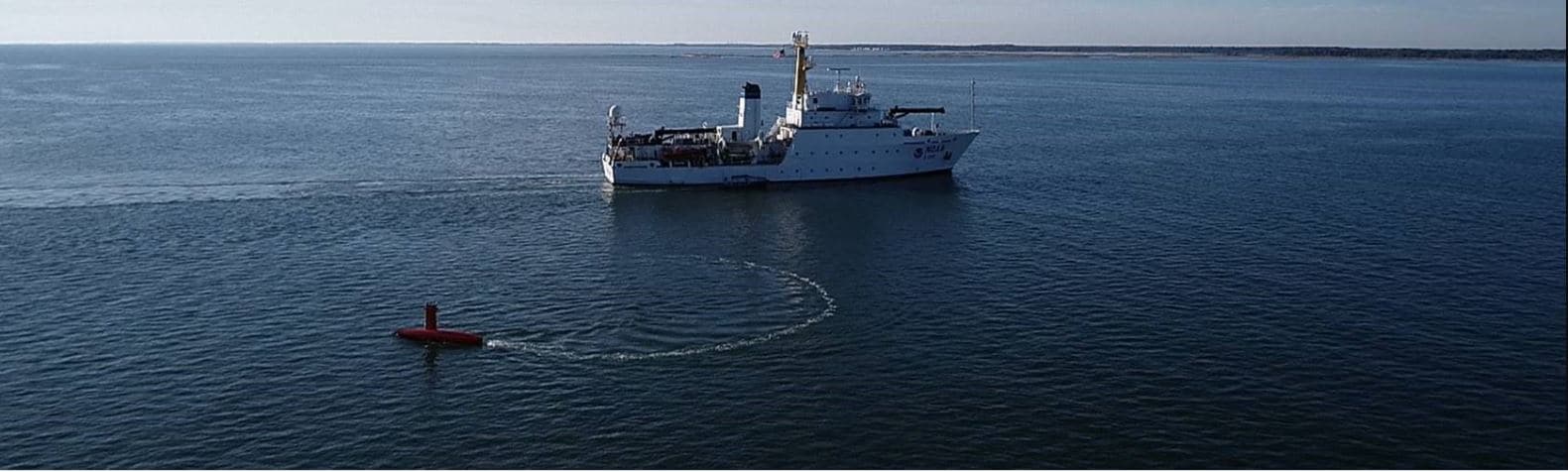
NOAA’ Ocean Exploration Cooperative Institute chooses DriX USV to help build the next generation ocean exploration system
The Ocean Exploration Cooperative Institute (OECI), funded by NOAA’s Office of Ocean Exploration and Research (OER) recently signed a purchase contract to acquire a DriX Unmanned Surface Vessel (USV) from high-tech company iXblue. Signed over the summer, this contract consists of one DriX USV along with a novel custom-designed Universal Deployment System able to launch and recover the USV as well as other AUVs. The autonomous solution is expected to be put to sea by mid-2021.
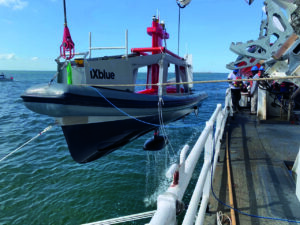 Along with the innovative Universal Deployment System, other features that led to the selection of the DriX were its mission endurance, ability to operate at high-speed and excellent offshore seakeeping ability.
“The ability to launch and recover unmanned surface vessels as well as other autonomous systems like AUV’s from the same launch and recovery system allows us to support a range of collaborative ocean exploration operations from a single research vessel, said Larry Mayer, Director of the Center of Coastal and Ocean Mapping and the University of New Hampshire’s co-PI on the Ocean Exploration Cooperative Institute. “With these collaborative, multi-vehicle operations we hope to greatly expand the footprint and efficiency of ocean exploration.”
The University of New Hampshire will operate the new DriX. The Ocean Exploration Cooperative Institute is funded by NOAA’s Office of Ocean Exploration and Research and is hosted at the University of Rhode Island in partnership with the University of New Hampshire, the University of Southern Mississippi, the Woods Hole Oceanographic Institution, and the not-for-profit Ocean Exploration Trust. This new five-year alliance is envisaged to extend NOAA’s reach and capabilities for its ocean exploration portfolio.
“We want to thank NOAA for trusting iXblue in being part of their new unmanned systems strategy,” states Marine Slingue, VP at iXblue, Inc. “We look forward to our continuous partnership and to helping them expand the development and operations of unmanned maritime systems in the U.S. coastal and world’s ocean waters.”
For more information please visit:
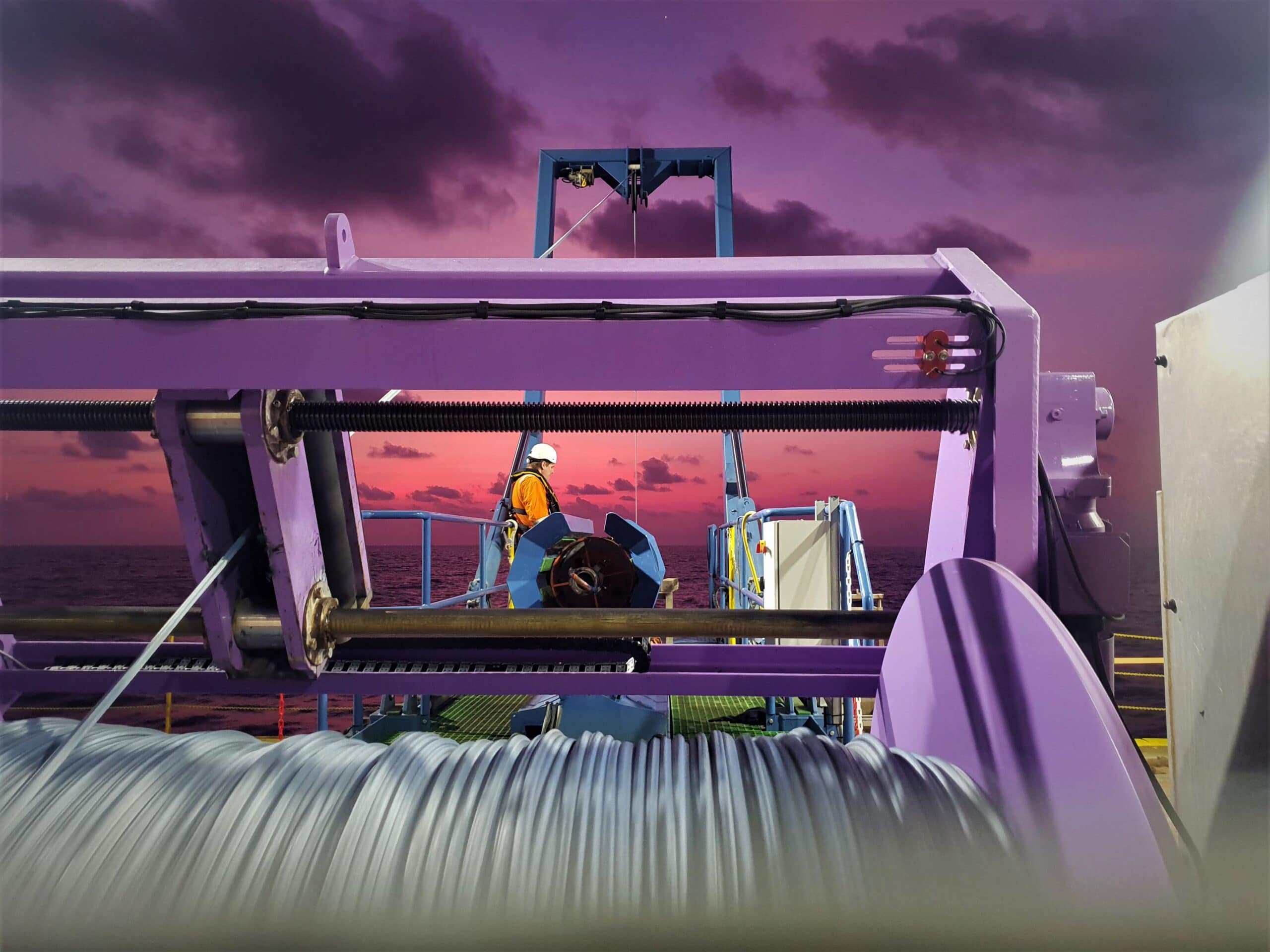
Feritech to open major new production facility in 2021
Feritech has announced that it is building a new, state of the art facility just outside Falmouth in Cornwall. Covering an area of 3.5 acres, the new site received planning approval this week. It will greatly increase Feritech‘s manufacturing capabilities and the services offered to both local customers and the company’s established global client base.
Founded in 2012, Feritech designs and builds subsea engineering solutions primarily for the marine geotechnical sector. All their products are designed, manufactured and tested at their own facilities. Over 90% of the company’s products and services are exported, with clients in more than 40 different countries.
Co-founder and Managing Director, Rob Ferris, explains:
“This new facility is a major step forward for our business. The development of Floating Offshore Wind is a fast growing regional and global opportunity and we are ramping up our capacity, partly so we can help accelerate development of this vital new industry. The new facility will be capable of handling up to 20 ton fabrications and is complemented with a new machining hall which can produce all manner of precision machined parts. Feritech’s design, electrical, electronic and hydraulic capabilities will also be expanded in line with the increased subcontract projects that we expect to fulfil.
“Research and development within the offshore renewable energy sector will always be a primary operation of the company and this facility will allow Feritech to undertake new challenges within this sector, providing solutions for customers quickly, while also tightly controlling the quality of the process from start to finish and all under one roof.”
Steve Jermy, CEO of Wave Hub Ltd, which is leading the South West Floating Offshore Wind Accelerator Project, says:
“The South West of the UK is set to become a world leader in floating offshore wind (FLOW). This exciting new development by Feritech exemplifies how innovative and forward looking businesses are rising to the challenge and will help to fast track the region's capacity to build out large scale wind farms in the Celtic Sea from 2025 onwards.”
Rob Ferris adds:
“The new building has also been designed to prove that our industry can work in harmony with the environment. The facility will harvest its own water, use ground source to heat the offices, and a solar roof with power storage to generate its own electricity. The site will have over 5,000 trees planted and use a pond to capture all the surface run off from the site. This will act as a heat store and provide vital new habitats for wildlife.”
Matt Hodson, Marine Hub Operations Director for Cornwall Development Company says:
“Ever since the company was founded, Feritech has been a leader, not a follower. They continually challenge themselves to develop world leading products that break the mould. This is another great example of a Cornish marine technology company that has rapidly become a global leader in its field. Companies like Feritech will be vital to our economic future, as we seek to recover from the impact of Covid while also grasping vital new growth opportunities, such as the massive potential that exists for Floating Offshore Wind power in the Celtic Sea.”
For more information please visit:
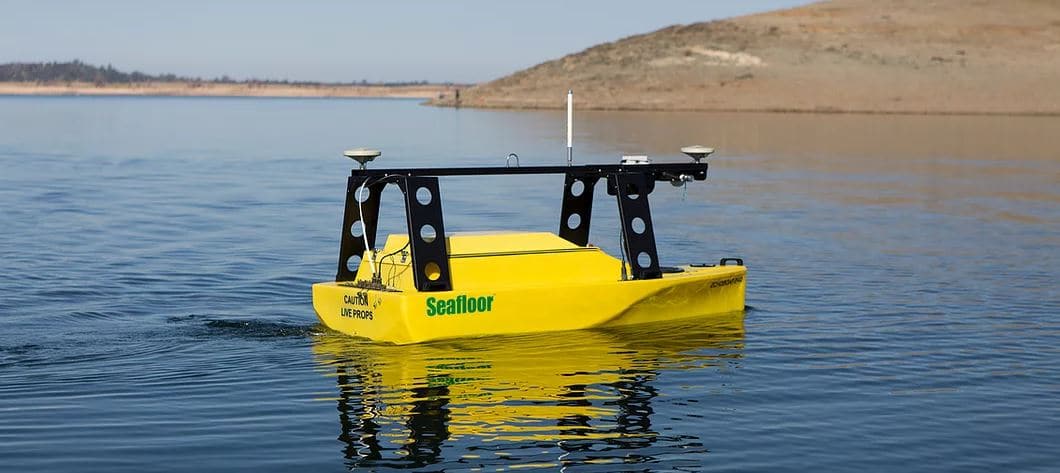
Seafloor EchoBoat-240™
Seafloor recently designed & delivered an EchoBoat-240™ USV to the U.S. Army Corps of Engineers, Los Angeles District. The Seafloor Systems EchoBoat-240™ is a scaled-up version of our standard workhorse EchoBoat-160™ remote controlled and autonomous survey platform. It was designed for applications requiring the highest resolution sensor suite available, and to be more stable in rough water environments.
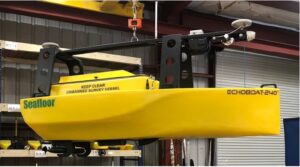
Ease of use was top of mind during development. The hinged water-tight lid quickly opens and closes, so all one has to do is power on the vessel, deploy it, and begin surveying. Live props reduce weed entanglement, and the SVP is encapsulated in the bow for protection. The wave-piercing hull was designed by our engineers to efficiently collect data and save time in the field.
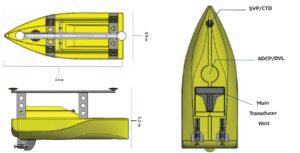
Equipment payload on the EchoBoat-240, fully integrated for use by the USACE:
• Teledyne SeaBat T50-R ultra high resolution Multibeam sonar (below)
• Integrated INS Type 20 INS/IMU (Applanix Wavemaster)
• AML Micro-X sound velocity sensor
• Valeport SWIFT sound velocity profiler
• HYPACK HYSWEEP Software
Still two person transportable, the Echoboat-240™ is ideal for launching from a trailer or cart in areas where a manned boat is not feasible. Seafloor’s field technicians collected some great data shots while training the Los Angeles District, U.S. Army Corps of Engineers to use their new autonomous vessel.
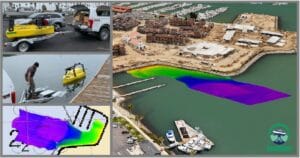
The Google Earth rendering shows a resulting data model from the onboard Teledyne RESON T-50 SeaBat multibeam sonar. The 2.4m / 7.87 ft vessel was right at home in this Ventura harbor, and is ready to become a hydrographic workhorse for the USACE.
For technical specifications and more information, please visit:
OFG and EMGS enter into a cooperation agreement
Ocean Floor Geophysics Inc (OFG) and Electromagnetic Geoservices ASA (EMGS) have announced today the signing of a cooperation agreement under which the two companies agree to work together on various projects to promote the use of marine CSEM technology.
The agreement places specific emphasis on exploiting the obvious synergies between the state-of-the-art towed-streamer CSEM system from OFG (under its exclusive right to acquire the PGS EM technology) and the industry-leading sea-bottom CSEM/MT nodal system from EMGS. Cooperation will include development of proprietary and multi-client surveys, and multiphysics reprocessing of existing seismic and CSEM data.
“We are delighted to have entered into this agreement with EMGS”, stated Richard Cooper, President of OFG Multiphysics. “Combining our technologies, expertise and market experience is an obvious next step for both companies and allows us to provide fast and efficient data acquisition and processing services over the widest possible range of marine environments for resource and environmental applications.”
“We see industry collaboration as key for advancing the EM technology. This agreement allows us to expand our acquisition offering to also include the towed-streamer technology and together with OFG we will continue to work on expanding the CSEM market and the range of CSEM applications”, said Bjørn Petter Lindhom, CEO of EMGS.
For more information:

Ultrabeam and USS team up to deliver Autonomous Pipeline Survey
Ultrabeam Hydrographic, a multi-award winning, dynamic and agile hydrographic survey company, recently teamed up with Unmanned Survey Solutions (USS) to conduct two subsea gas pipeline inspection surveys in Northern Ireland. Both companies are based in the UK and offer unmanned platforms as an alternative to traditional manned survey vessels.
The contract was awarded by Mutual Energy who were keen to gain experience on how unmanned autonomous platforms can increase the knowledge of their pipelines whist reducing risk and overall cost. Shane Rafferty, Group Engineer explained ‘Mutual Energy contracted with Ultrabeam Hydrographic in August 2020, following an open competitive tendering process, to perform inspection surveys of our Larne and Belfast lough crossing pipelines, key components of Northern Ireland’s natural gas transmission network. In a first for Mutual, an Unmanned Survey Vessel (USV), the “USS Accession”, provided by Ultrabeam’s project partners Unmanned Survey Solutions, was to be deployed. The project planning phase moved swiftly and seamlessly such that execution of the works commenced only a matter of a few weeks later, and was performed as programmed despite some inclement weather and sea states. We were pleased to see early data capture and quality provide assurance of equal standards to previous surveys, such that the assets could be returned a clean bill of health. Mutual Energy would like to thank the entire project team from Ultrabeam Hydrographic and Unmanned Survey Solutions for their diligence and expertise in successfully delivering the project, and can commend the benefits of the innovative technology for such nearshore surveys’
The challenges faced by these route surveys were solved by using an Accession Class USV built by USS. This 3.5m USV was fitted out with an R2SONIC 2024 high resolution multi-beam sonar, SBG Ekinox Navsight Inertial Navigation System and sound velocity sensors from Valeport. The data was acquired in QINSy which was also used as the autopilot for the autonomous line running. James Williams commented ‘the survey conditions were marginal with strong winds, tidal currents and waves however the vessel’s stabilisation fins ensured that the data was exceptionally clean. We were also able to get closer inshore than on any previous surveys using manned vessels. The vessel was really put through its paces on these deployments and I’m pleased to say that it performed beyond everyone’s expectations’.
Ultrabeam is backed by decades of experience in coastal hydrographic and geophysical survey. They also build their own unmanned platforms for detailed sonar and laser asset inspection. Project Manager Simon Baldwin commented; ‘’We are very happy to have provided Mutual Energy with a great dataset and deliverables as part of their 2020 subsea pipeline inspection campaign. The environmental conditions on site in Northern Ireland were far from benign and the USV and operational team worked faultlessly to provide great bathymetric data, safely and efficiently. This project was an ideal opportunity for us to continue to show what can be achieved autonomously, on schedule and to a high standard.’’
Two pipeline surveys were conducted along the Larne and Belfast Loughs using the Accession 350 USV. The weather was marginal, no incidents occurred and the project was completed on time and to budget. The joint venture between Ultrabeam and USS proved that autonomous surveys of inshore pipeline can be conducted safely and cost effectively compared to traditional manned solutions.
More info:
www.unmannedsurveysolutions.com

RS Aqua’s Underwater Acoustic Recorder deployed on the Mayflower Autonomous Ship
After its official launch in September, the Mayflower Autonomous Ship is now undertaking testing to prepare for its transatlantic voyage in Spring 2021.
An RS Aqua Porpoise passive acoustic recorder will be deployed on the ship, and will collect a broad spectrum of underwater noise data throughout the voyage. These data will be automatically processed and categorised by IBM systems on the Mayflower, ready for further analysis by University of Plymouth marine mammal experts. The Porpoise recorder is uniquely suited to the challenge as it can stream its data over Ethernet for real time processing, and has a broadband listening capability that can hear everything from low human made noise to the highest frequency ultrasonic cetacean vocalisations. These data will form the first ever autonomously recorded soundscape of the Atlantic Ocean and give a unique insight into the different marine mammal species encountered by the Mayflower.
Dr Ryan Mowat, Director at RS Aqua commented: “Specifying and providing the Mayflower with a customised version of one of our Passive Acoustic Monitoring recorders was a proud moment for RS Aqua. We’ve found that the streaming capability of our recorders is a necessity for autonomous platforms as it allows these vessels to interpret their environment acoustically in real time. Our recorders can provide an acoustic assessment of the surrounding marine environment as they move through it, and this is important for all sorts of applications, such as vessel navigation, asset tracking, marine mammal observation and defence. This is the fifth unique recorder integration we’ve done, and we’ll be working closely with the Mayflower team during the vessel trials to ensure it is optimised to gather new data on North Atlantic cetacean populations.”
For more information, visit https://www.mas400.com/technology and www.rsaqua.co.uk .
MacArtney Completes LARS Delivery for Fifth Ocean Research Vessel to Asia Pacific Operations
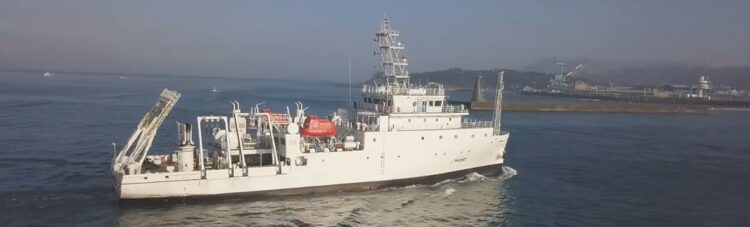
MacArtney has successfully completed its order of a launch and recovery (LARS) system for end-user Taiwan National University, marking the fifth Ocean Research Vessel (ORV) in the Asia Pacific region to date.
MacArtney Asia Pacific has provided the full launch and recovery system solution for the new vessel R/V New Ocean Researcher 1 (ORV 1), including slip rings, cables and docking heads. With the successful completion of the 1,000 GT (gross tonnage) research vessel on 21 July 2020, MacArtney can add another milestone to its credentials.
Behind ORV 1 is the CSBC Corporation, which built the ship for end-user Taiwan National University. CSBC, owning two shipyards, is the largest shipbuilding company in Taiwan. Now that ORV 1 has passed its Sea Acceptance Test (SAT) with flying colours, researchers from the country’s national university can reap the benefits of a highly advanced level of technology that includes no less than three MacArtney MERMAC LARS systems.
Not problems, but challenges
Naturally, a project of this scale was not without obstacles, but MacArtney’s experienced engineers and technicians took these in their stride. Speaking at the handover ceremony, the positive mindset of the MacArtney Group was highlighted by the director of the outfitting factory,
Mr Liang Hong-yu:
“Of course, we encountered difficult situations and problems. Whenever this happened, I think of what a Danish engineer, Steen, said to me – “Not a problem, always a challenge”. In the process of commissioning, he used this sentence to encourage me – to make me face the challenge with a positive attitude, and I remember it clearly even now.”
The full scope of supply for the launch and recovery system aboard ORV 1 comprises:
- One MERMAC stern A-frame (15 metres)
- Two MERMAC side A-frames
- Wireless remote control foldable boom crane with 10-tonne capacity and active heave compensation
- Hydraulic power units for A-frame and crane
- MERMAC storage and traction winch with 6,000 metres of ready spooled stainless steel wire, wireless remote control and constant tension technology
- MERMAC CTD (Conductivity, Temperature, Depth) winch, including 6,000 metres of armoured coaxial cable and slip rings
- Portable MERMAC winch with 4,500 metres of hybrid instrumentation cabling, slip ring and spare cable
Commenting on the successful outcome of the project, MacArtney’s Managing Director of Asia Pacific Operations, Steen Frejo, states:
“We are pleased to have completed this project to the satisfaction of our customer, CSBC, and of being able to assist the National Taiwan University with advanced, high-quality winch and handling systems to support their research missions in the years to come.”
The new research vessel cements MacArtney’s close working relationship with the CSBC Corporation, following on from the development of ORV 2 and ORV 3, launched in November 2019. Management of ORV 1 will now be handed over to Taiwan National University.
For more information, visit macartney.com